Life & Legacy
Early Life
Radha Govinda Baruah was born on 17 October 1900 in Sivasagar, Assam, during the British colonial period. From an early age, he displayed exceptional intelligence, discipline, and leadership qualities. Growing up in an environment that valued education and hard work, he developed a strong desire to contribute towards the social and economic progress of Assam. Even as a young student, he demonstrated remarkable entrepreneurial abilities and a passion for building institutions that would benefit society.
Education
He completed his early education in Sivasagar, Nagaon, and Dibrugarh before joining the prestigious Cotton College in Guwahati. During his student life, financial challenges encouraged him to become self-reliant. He undertook several small business activities to support his education and later moved to Kolkata, where he studied accountancy and gained valuable business experience. His practical approach to learning and entrepreneurship became the foundation of his future achievements.
Early Career and Entrepreneurship
Before becoming a newspaper pioneer, Radha Govinda Baruah established himself as a successful entrepreneur. He worked in various business sectors, including insurance, trade, and printing. He became one of the leading insurance professionals in eastern India and played a pioneering role in promoting life insurance awareness across Assam at a time when very few people understood its importance.
Another milestone in his career came when he was instrumental in establishing the first branch of the Imperial Bank of India (now the State Bank of India) in Assam. This achievement greatly strengthened the state's banking infrastructure and supported the region's growing commercial activities.
His entrepreneurial vision, combined with his commitment to public welfare, made him one of Assam's earliest modern business leaders.
Founding of The Assam Tribune
One of Radha Govinda Baruah's greatest contributions was the establishment of The Assam Tribune. Understanding the need for an independent English newspaper representing the voice of Assam, he launched the publication in 1939 after initially starting an English weekly newspaper in 1938.
Under his leadership, The Assam Tribune became a trusted and respected newspaper known for factual reporting, editorial independence, and balanced journalism. The newspaper gradually grew into one of Northeast India's most influential media organizations and continues to uphold the values established by its founder.
Later, he expanded the media group by introducing other publications, including Axombani and Dainik Asam, thereby strengthening Assamese journalism and promoting regional language newspapers.
Contribution to Journalism
Radha Govinda Baruah believed that journalism should serve society without political influence or commercial pressure. Despite being the proprietor of The Assam Tribune, he respected editorial independence and encouraged ethical journalism.
His newspapers became platforms for discussing education, culture, economic development, agriculture, literature, and public policy. Through responsible journalism, he helped create awareness among citizens and promoted democratic values across Assam.
His contribution laid the foundation for modern journalism in Northeast India and remains one of his most enduring legacies.
Contribution to Sports
Radha Govinda Baruah was equally passionate about sports and believed that athletics played an important role in building a healthy and disciplined society. Throughout his life, he actively promoted football, cricket, athletics, badminton, tennis, and wrestling.
His biggest sporting achievement was leading the construction of Nehru Stadium in Guwahati, which became Assam's premier sports venue and hosted numerous national and international sporting events. He also organized major wrestling events featuring legendary wrestler Dara Singh to raise funds for sports infrastructure.
His efforts helped transform Assam into one of Northeast India's leading sporting destinations and encouraged thousands of young athletes to pursue sports professionally.
Radha Govinda Baruah believed that sports could transform society by promoting discipline, teamwork, and healthy living. His vision helped establish Assam as an important center for sporting activities in Northeast India. He served in leadership roles in several sports organizations, including the Assam Cricket Association, Assam Football Association, Guwahati Sports Association, Guwahati Town Club, and other sporting bodies.
One of his greatest achievements was leading the construction of the historic Nehru Stadium in Guwahati. Completed during the early 1960s, the stadium became one of the state's most important sporting venues and hosted numerous national and regional competitions. Baruah also played an active role in encouraging young athletes and promoting cricket, football, tennis, badminton, and other sports throughout Assam.
His efforts laid the foundation for the long-term development of sports infrastructure in the state. In recognition of his remarkable contribution, Assam Sports Day is observed every year on 17 October, his birth anniversary.
He served as President of several important sports organizations, including:
- Assam Cricket Association
- Assam Football Association
- Guwahati Sports Association
- Guwahati Town Club
- Assam Badminton Association
- Assam Lawn Tennis Association
Contributions to Education
Education was one of Radha Govinda Baruah's lifelong priorities. He believed that a strong education system was essential for the social and economic development of Assam. Throughout his career, he encouraged educational institutions, promoted quality learning, and supported initiatives that would benefit future generations.
He was instrumental in identifying the educational needs of the Assamese people and consistently advocated for improved access to higher education. His commitment to education is reflected in the establishment of Radha Govinda Baruah College in Guwahati, which was named in his honour after his passing. The institution continues to provide higher education to thousands of students and preserves his vision of empowering society through knowledge.
Contributions to Assamese Culture
Apart from journalism and public service, Radha Govinda Baruah made outstanding contributions to preserving and promoting Assamese culture. He understood the importance of protecting the state's rich traditions while presenting them to wider audiences.
He was among the key personalities behind the popularization of organized Bihu celebrations in Guwahati. The Guwahati Bihu Sanmilan helped transform traditional rural Bihu performances into well-organized cultural festivals that are now celebrated annually by thousands of people.
He also co-founded the Assam Sangeet Sanmilan to promote classical and folk music and supported the establishment of the Assam College of Music. Through these initiatives, he encouraged talented artists, musicians, and performers, helping preserve Assam's cultural identity for future generations.
Contributions to Assam's Tea Industry
Radha Govinda Baruah also played a visionary role in strengthening Assam's tea economy. As President of the Assam Tea Brokers' Association, he actively supported the establishment of the Guwahati Tea Auction Centre in 1970.
Before this initiative, most tea auctions were conducted in Kolkata. The creation of the Guwahati Tea Auction Centre allowed Assam's tea industry to conduct auctions within the state, reducing dependency on outside markets and improving business opportunities for tea producers. This milestone greatly strengthened Assam's position in the global tea industry and remains one of his lasting economic contributions.
Public Service and Civic Leadership
Radha Govinda Baruah's dedication to public welfare extended beyond journalism and business. He became the first Mayor of Guwahati and worked tirelessly to modernize the city. During his tenure, he emphasized better civic administration, urban planning, sanitation, and public infrastructure.
His leadership helped shape Guwahati into a growing urban center while maintaining its cultural heritage. He believed that responsible civic administration was essential for sustainable development and continuously encouraged public participation in community welfare.
His practical approach to governance and institution-building earned him immense respect across political and social circles.
Major Achievements
Some of the most significant achievements of Radha Govinda Baruah include:
- Founder of The Assam Tribune, one of Northeast India's most respected English newspapers.
- Established Baruah Press and promoted independent journalism.
- Instrumental in making The Assam Tribune a leading newspaper of Assam.
- Popularly known as the Architect of Modern Assam.
- Served as the first Mayor of Guwahati.
- Led the development of Nehru Stadium in Guwahati.
- Promoted cricket, football, tennis, badminton, and other sports across Assam.
- Played a major role in establishing the Guwahati Tea Auction Centre.
- Helped expand financial awareness through banking and insurance initiatives.
- Promoted Assamese music, theatre, and traditional Bihu celebrations.
- Supported the establishment of important educational and cultural institutions.
- Inspired generations through ethical leadership, entrepreneurship, and public service.
Awards and Recognition
Radha Govinda Baruah received widespread recognition for his lifelong service to Assam.
His major honours include:
- Widely honoured as the "Architect of Modern Assam."
- Popularly known as "Singhapurush" (Lion Man) for his courage and leadership.
- Remembered as "Rupkhanikar" for his contribution to building modern institutions.
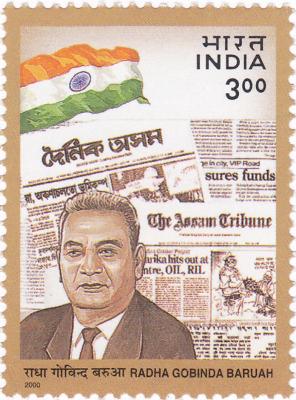
- Government of India issued a commemorative postage stamp in his honour in 2000.
- Assam Sports Day is celebrated annually on 17 October to commemorate his birth anniversary.
- Radha Govinda Baruah College was established to honour his educational contributions.
- Various memorial awards, lectures, and sports competitions continue to celebrate his legacy.
Death
Radha Govinda Baruah passed away on 15 July 1977 in Guwahati, Assam, at the age of 76. His death marked the end of an extraordinary chapter in Assam's history, but his vision continues to inspire generations.
Even decades after his passing, his contributions to journalism, sports, education, business, and public administration remain deeply embedded in Assam's development. His institutions continue to serve society, making him one of the most respected and influential personalities in the history of the state.
FAQs on Radha Govinda Baruah
1. Who was Radha Govinda Baruah?
Radha Govinda Baruah was an eminent Assamese entrepreneur, journalist, sports organizer, civic leader, and founder of The Assam Tribune. He is widely remembered as the Architect of Modern Assam for his remarkable contribution to the state's development.
2. Why is Radha Govinda Baruah called the Architect of Modern Assam?
He earned this title because of his pioneering work in journalism, education, sports, business, urban development, and cultural preservation, which significantly influenced Assam's modernization.
3. When and where was Radha Govinda Baruah born?
Radha Govinda Baruah was born on 17 October 1900 in Sivasagar, Assam, India.
4. What is Radha Govinda Baruah famous for?
He is best known for founding The Assam Tribune, promoting sports in Assam, establishing important public institutions, supporting education, and serving as the first Mayor of Guwahati.
5. What newspaper was founded by Radha Govinda Baruah?
He founded The Assam Tribune in 1939, which later became one of the most respected English-language newspapers in Northeast India.
6. What were the major contributions of Radha Govinda Baruah to sports?
He promoted cricket, football, tennis, and other sports, led the development of Nehru Stadium in Guwahati, and served as president of several major sports organizations in Assam.
7. What role did Radha Govinda Baruah play in Assam's tea industry?
He was instrumental in establishing the Guwahati Tea Auction Centre, which strengthened Assam's tea trade by enabling auctions to be conducted within the state.
8. What honours did Radha Govinda Baruah receive?
He is remembered as the Architect of Modern Assam and Singhapurush. The Government of India issued a commemorative postage stamp in his honour, and Assam celebrates Assam Sports Day on his birth anniversary.
9. When did Radha Govinda Baruah pass away?
Radha Govinda Baruah passed away on 15 July 1977 in Guwahati, Assam.
10. Why is Radha Govinda Baruah still remembered today?
He is remembered for establishing lasting institutions in journalism, sports, education, business, and public administration that continue to benefit Assam and inspire future generations.