In Depth
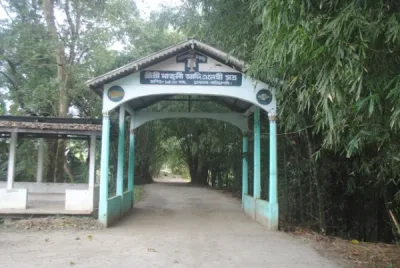
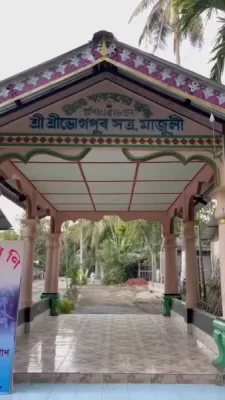
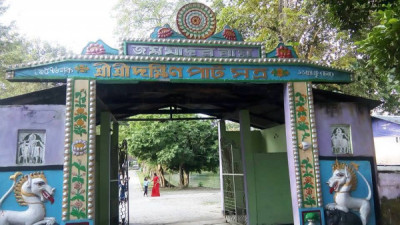
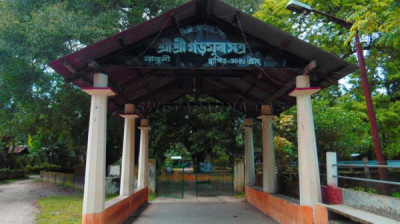
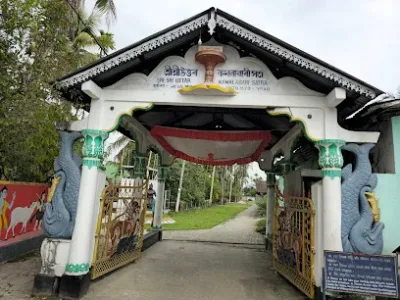
Beyond its religious importance, Auniati Satra is known for its museum, historical collections, traditional monastery architecture, Sattriya performances and annual festivals. It is an important destination for visitors interested in the history and cultural heritage of Majuli.
History of Auniati Satra
Auniati Satra is generally dated to 1653 CE and is associated with Ahom King Jayadhwaj Singha, also known as Sutamla. Sri Sri Niranjana Deva Goswami is recognised as its first Satradhikar. Historical accounts state that the king received Vaishnava initiation from the spiritual head of the institution and subsequently supported the Satra through substantial grants of land under the Devotra and Brohmotra categories.
The name Auniati is traditionally explained through two local terms: Auni Paan, a variety of betel creeper that grew in the area, and Ati, meaning elevated land. The monastery was established on slightly raised ground where this plant was found, giving rise to its name.
Auniati Satra became an influential religious institution during the Ahom period and received royal patronage. Its contribution extended beyond worship to education, literature, devotional music, cultural performances and the organisation of religious gatherings. It continues to be an important centre of Assamese Vaishnavite traditions.
Lord Govinda and Religious Significance
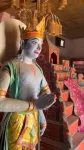
The central object of worship at Auniati Satra is Lord Govinda, a form of Lord Krishna. According to the Satra's traditional account, the idol was brought from Jagannath Kshetra in Puri, Odisha, and installed with religious ceremonies. Daily worship and devotional offerings are conducted in the Manikuta, the inner sanctum of the monastery.
The Satra follows the Brahma Sanghati tradition within the wider Ekasarana Dharma movement. Its religious activities include Sharan, Bhajan, Naam-Prasanga and other devotional observances. The Satradhikar and senior religious leaders guide the community in these practices.
Monastery Layout and Architecture
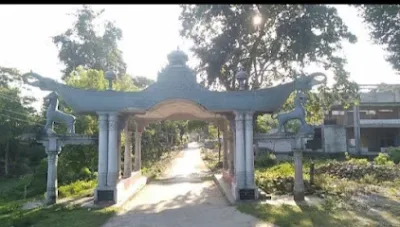
Auniati Satra follows the traditional layout of an Assamese Vaishnavite monastery. The central Namghar serves as the main prayer and congregation hall, while the Manikuta houses the principal deity. Rows of residential buildings known as Baha or Hati surround the central religious spaces.
The resident bhakats live in these quarters and follow the discipline and devotional routine of the Satra. The complex also includes areas associated with the Satradhikar, traditional storage structures, ponds and other facilities. This arrangement reflects the role of a Satra as both a spiritual institution and a community centre.
Auniati Satra Museum and Historical Collections
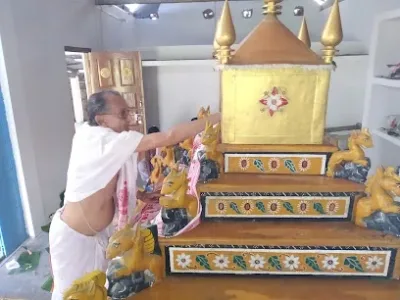
The Auniati Satra Museum is an important attraction for visitors interested in Assam's history. Its collections include objects connected with the Ahom period, Vaishnavite traditions and the cultural life of the monastery. Depending on the exhibits available, visitors may see traditional utensils, musical instruments, religious objects, manuscripts, historical weapons, clothing and items associated with Assamese devotional performances.
The museum provides a useful introduction to the relationship between the Ahom rulers and the development of Vaishnavite institutions in Assam. It also helps visitors understand the artistic and material traditions preserved by the Satra over generations.
What to See and Experience at Auniati Satra
1. Namghar and Manikuta
The Namghar is the central prayer hall where devotees gather for devotional singing, prayers and religious ceremonies. The Manikuta is the sanctum where Lord Govinda is worshipped. These spaces form the spiritual heart of the Satra.
2. Auniati Satra Museum
Explore the museum to learn about the monastery's history and view objects associated with Assamese religious, artistic and royal heritage. It is especially interesting for visitors who want to understand the cultural history of Majuli.
3. Traditional Baha and Hati
The rows of residential quarters offer an insight into the communal and disciplined lifestyle of the resident bhakats. Their arrangement around the central religious buildings is a distinctive feature of traditional Satra architecture.
4. Sattriya Dance and Devotional Music
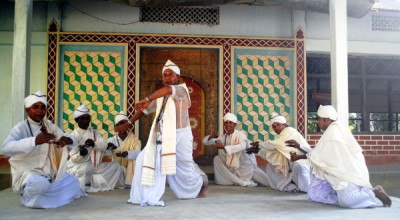
Auniati Satra preserves several forms of Sattriya performance, including Natua, Apsara, Sutradhar, Jumura, Sali and Krishna-Gopi Nritya. Devotional music and Gayan-Bayan, which combines singing and traditional percussion, are also important parts of its cultural tradition. Performances are particularly associated with religious occasions and festivals.
5. Traditional Religious and Cultural Activities
Visitors may learn about Naam-Prasanga, Bhajan, Bhaona and other devotional practices followed by the Satra. Actual performances and access to particular areas depend on the religious calendar and the permission of the Satra authorities.
Festivals Celebrated at Auniati Satra
Paal Naam is one of the most significant annual religious observances at Auniati Satra. It is traditionally held over several days during the Assamese month of Kartika, with devotees gathering for continuous prayer, devotional singing and religious activities.
Other important celebrations include Raas Leela, Janmashtami, Holi, Diwali, Bohag Bihu and Kati Bihu. The Satra also observes the death anniversaries of former Satradhikars and Vaishnavite spiritual leaders. These occasions provide an opportunity to experience the living devotional and cultural traditions of Majuli.
Branches of Auniati Satra
Auniati Satra has several branches beyond its main establishment in Majuli. Its North Guwahati branch was established in 1915 and is situated on the northern bank of the Brahmaputra, opposite Guwahati city. Another important branch is located at Kaliapani near Teok in the Jorhat region. The institution has also established branches in other locations, including Naharlagun and Dibrugarh, according to its historical and institutional accounts.
These branches extend the Satra's religious and cultural activities beyond Majuli and serve devotees in different parts of the region.
Present Satradhikar
Dr. Sri Sri Pitambar Dev Goswami is identified in the supplied institutional history as the 16th Satradhikar of Auniati Satra. He assumed the position in 1998 after the passing of the previous Satradhikar, Sri Sri Bishnu Chandra Deva Goswami.
He joined Auniati Satra as a young Govindapuriya in 1969 and received his early spiritual education within the institution. He later studied at Gauhati University, completed postgraduate studies in Assamese literature and pursued Sanskrit learning. He also earned a PhD from Dibrugarh University for research on the significance of Sattriya festivals.
During his tenure, initiatives included the revival of the Dharma Prakash Yantra press and the publication of the cultural journal Sanskriti Pallav. His work has contributed to promoting Sattriya culture and bringing greater attention to Majuli's religious heritage.
List of Past Satradhikars of Auniati Satra
Sri Sri Auniati Satra has been guided by a succession of spiritual heads, known as Satradhikars, since its establishment in Majuli. The following list records the names and tenure periods of its former Satradhikars.
| Sl. No. | Name of Satradhikar | Tenure |
|---|---|---|
| 1 | Sri Sri Niranjan Deva Goswami | 1656–1658 AD |
| 2 | Sri Sri Keshav Deva Goswami | 1658–1726 AD |
| 3 | Sri Sri Ram Chandra Deva Goswami | 1726–1727 AD |
| 4 | Sri Sri Damodar Deva Goswami | 1727–1737 AD |
| 5 | Sri Sri Hari Deva Goswami | 1737–1760 AD |
| 6 | Sri Sri Pranahari Deva Goswami | 1760–1785 AD |
| 7 | Sri Sri Lakhi Nath Deva Goswami | 1785–1804 AD |
| 8 | Sri Sri Padmapani Deva Goswami | 1804–1818 AD |
| 9 | Sri Sri Lakhi Ram Deva Goswami | 1818–1821 AD |
| 10 | Sri Sri Kusha Ram Deva Goswami | 1821–1838 AD |
| 11 | Sri Sri Dutta Deva Goswami | 1838–1904 AD |
| 12 | Sri Sri Kamal Chandra Deva Goswami | 1904–1922 AD |
| 13 | Sri Sri Lila Kanta Deva Goswami | 1922–1926 AD |
| 14 | Sri Sri Hem Chandra Deva Goswami | 1926–1983 AD |
| 15 | Sri Sri Bishnu Chandra Deva Goswami | 1983–1998 AD |
Best Time to Visit Auniati Satra
October to March is generally the most comfortable period to visit Auniati Satra. The weather is usually more suitable for exploring Majuli during these months. November is especially interesting for visitors who wish to experience the Raas celebrations and other cultural activities across the island.
The monsoon season can bring heavy rainfall and changes in river conditions, which may affect ferry services and local travel. Winter visitors should carry warm clothing, particularly for early mornings and evenings.
How to Reach Auniati Satra from Guwahati
Auniati Satra is situated in Majuli, approximately 5 km from Kamalabari, the island's main township. The most commonly used route from Guwahati is through Jorhat and Nimati Ghat.
By Road: Guwahati is approximately 300–320 km from Jorhat, depending on the route. Travel by bus, private taxi or personal vehicle via the highway towards Jorhat. From Jorhat, Nimati Ghat is around 14 km away by road.
By Train: Jorhat Town and Mariani Junction are useful railway stations for reaching the region. From the station, hire a taxi or use local transport to travel to Nimati Ghat.
By Air: Jorhat Airport, also known as Rowriah Airport, is the nearest airport serving Majuli. From the airport, continue by road to Nimati Ghat.
By Ferry: Take a ferry from Nimati Ghat to Majuli. Services generally connect the mainland with ferry points such as Kamalabari, although the destination and timetable depend on the service operating that day. The crossing commonly takes around 45–90 minutes, subject to river conditions and the type of vessel.
From Kamalabari to Auniati Satra: After reaching Majuli, hire a local taxi, auto or other available transport to Auniati Chapori. The Satra is approximately 5 km from Kamalabari.
An alternative approach to Majuli is through Luit-Khabalughat on the north bank of the Brahmaputra, but the Jorhat–Nimati Ghat route is commonly used by visitors. Ferry schedules can change, so confirm the latest departure and return arrangements before starting your journey.
Where to Stay Near Auniati Satra
Auniati Satra is a functioning religious monastery rather than a regular hotel or tourist lodge. General visitors should not assume that rooms are available for overnight stays inside the complex. Anyone seeking a special guest arrangement or spiritual stay should contact the Satra administration in advance and follow its accommodation rules, including any applicable restrictions.
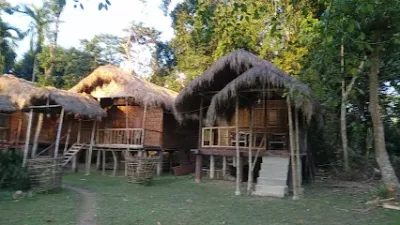
For ordinary tourist accommodation, visitors can look for homestays, guesthouses and bamboo cottages around Kamalabari and Garamur. These locations provide convenient bases for exploring Auniati Satra and other attractions across Majuli. It is advisable to book ahead during Raas Mahotsav and other busy travel periods.
Where to Stay in Majuli – Accommodation Directory
Resorts, Bamboo Cottages and Eco Camps
Accommodation | Address | Phone / Contact |
|---|---|---|
Dekasang Resort | Sitadar Chuk, near River Luit, Garmur Chariali, Majuli, Assam 785104 | +91 9854715435, +91 8134074656, +91 8724994315; alternate number supplied: +91 84748 38295 |
Prashaati Tourist Complex | NLK Road, near Kamalabari Ferry Ghat, Kamalabari Satra, Bhogpur Satra, Majuli, Assam 785106 | +91 3775-2730901, +91 9854858353, +91 9435734138, +91 9401094734 |
Ygdrasill Bamboo Cottage | Jengraimukh Road, Doria Gaon, Majuli, Assam 785104 | +91 8876707326 |
Resort Sunrise Majuli | Borun Chitadar Chuk Sunapur, Bukura, Majuli, Assam 787052 | +91 8811987272 |
Mahabahu Bamboo Cottage | KB Road, Pohar Dia, near Kamalabari Satra, Majuli, Assam 785106 | +91 7578057332, +91 6000746273 |
Ayang Okum River Bank Bamboo Cottage | Sitadar Chuk, near River Luit, Chariali, Garmur, Kaibortta Gaon, Majuli, Assam 785104 | +91 9435546455 |
Majuli Pushpa Bilash (Bamboo Resort) | Near Uttar Kamalabari Satra, Garamur Phutuki Chapori, Majuli, Assam 785106 | +91 7576080881, +91 6001684768 |
Enchanting Majuli Resort | Near Veterinary Field, Garamur Chariali / Natun Kulamora Chapori, Majuli, Assam 785104 | +91 943506217, +91 7002438179 |
Mepo Okum Eco Camp | Kaibortta Gaon, Majuli, Assam 785104 | +91 9435203165, +91 8011209038, +91 9862345965 |
Jonki Panoi Bamboo Cottages by WCH | Dhapak Chari, Upper Katoni, near Kamalabari Satra, Majuli, Assam 785106 | +91 7399888822 |
SIANG The Island Resort | Chitadar Chuk, Garamur, Majuli, Assam 785104 | +91 6901518823 |
River Wind Cottage | DC Court Road, Garamur Phutuki Chapori, Monika Pathar, Majuli, Assam 785104 | +91 9435203024 |
Ruwad: Okum Bamboo Cottages | Chitadar Chuk, Garamur Phutuki Chapori, Majuli, Assam 785104 | +91 93946 96559 |
Shantikunj Bamboo Cottage | Garamur Saru Satra, opposite Veterinary Sub-centre, Garamur Chariali, Majuli, Assam 785104 | +91 98643 48113 |
Homestays, Guest Houses and Lodges
Accommodation | Address | Phone / Contact |
|---|---|---|
Okegiga Homes | Chitadar Chuk, Garamur Phutuki Chapori, Majuli, Assam 785104 | +91 8822390306; alternate formatting supplied: +91 88223 90306 |
La Maison de Ananda | Natun Kulamora Chapori N.C., Majuli, Assam 785104 | +91 9957186356 |
Sukanya Home Stay | Kamalabari, Majuli, Assam 785104 | +91 9101829796 |
Dutta Guest House | Kamalabari, Majuli, Assam 785104 | +91 9435292582 |
Niribili Home Stay / Niribili Homestay | Kamalabari Chariali, Uttar Kamalabari Satra Road, near Kamalabari CHC Campus Road, Majuli, Assam 785106 | +91 9864165280, +91 9435788736, +91 6001047487 |
Seuj Bilas | Kamalabari, Majuli, Assam 785104 | +91 9435734138 |
Jyoti Home Bamboo Garden Lodge / Jyoti Bamboo Garden Homestay | Kulamora Chapori N.C., near Namghar, Garamur Saru Satra, Majuli, Assam 785104 | +91 9435657282 |
Risong Family Guest House | Garamur Chariali, near Garmur Satra, Natun Kulamora Chapori N.C., Majuli, Assam 785104 | +91 9957186356 |
Hotel Srimanta Sankardev, Majuli | NLK Road, Garmur, Majuli, Assam 785104 | +91 9435570844, +91 8099032340, +91 7905985108 |
Rupali Tant Ghar and Homestay | Tourism Tiniali, Auniati Road, Kamalabari Chariali, Doria Gaon, Majuli, Assam 785106 | +91 9101829796, +91 9435656888 |
Apun Majuli Guest House | Majuli College Road, Kamalabari Satra, Kamalabari Chariali, Majuli, Assam 785106 | +91 9864777937; another supplied listing did not provide a number |
Maa Sumthira Lodge | Garamur Satra Road, Natun Kulamora Chapori N.C., Majuli, Assam 785104 | +91 9365774128 |
Uttar Kamalabari Satra Guest House | Garamur Phutuki Chapori, Majuli, Assam 785106 | +91 9954984797 |
Ratul Homestay | 2 No. Phutuki, Garamur, Kamalabari, Majuli, Assam 785106 | +91 9435546252, +91 9365153707 |
Dharitry Homestay Majuli | Doria Gaon, Majuli, Assam 785106 | +91 9394125107, +91 9864534329 |
Sugandhalok Homestay | Upper Katoni, near NLK Road, Majuli, Assam 785106 | +91 9435614417 |
Trishna Homestay | Upper Katoni Road, near Natun, near Water Supply, Kamalabari Satra, Majuli, Assam 785106 | +91 9864701250, +91 9365620873 |
Tourism and Travel Contacts
Organisation / Service | Contact Details |
|---|---|
Visit Majuli | +91 92095 10723; bookings@visitmajuli.com |
Majuli Tourism | +91 94356 57282 |
Majuli River Island / Jungle Ideas Tourism | +91 70868 73676; WhatsApp: +91 60016 85490; jungleideastourism@gmail.com |
Assam Tourism – Log Hut Enquiries | +91 98548 58353 |
Whom to Contact
For information about visiting the Satra, religious activities, accommodation enquiries or cultural programmes, contact the institution directly:
Other email addresses listed in the supplied contact information are:
Visitors should confirm the current contact details and access arrangements before travelling.
Visitor Tips
Dress respectfully when entering religious areas.
Follow instructions from the Satra authorities and resident bhakats.
Ask permission before photographing the Manikuta, prayer activities, residents or museum exhibits.
Check whether the museum and cultural areas are open to visitors on your chosen day.
Confirm ferry timings before travelling to Nimati Ghat.
Keep enough time for the return ferry, especially if visiting from Jorhat on a day trip.
Auniati Satra is an important destination for understanding the religious history and cultural identity of Majuli. Its association with Lord Govinda, Ahom royal patronage, traditional monastery life, museum collections and Sattriya performances makes it a valuable stop for anyone exploring the heritage of Assam.
Quick Information Table
Particulars | Details |
|---|---|
Name | Sri Sri Auniati Satra |
Location | Auniati Chapori N.C., Majuli, Assam, India |
PIN Code | 785106 |
Established | 1653 CE (commonly cited) |
First Satradhikar | Sri Sri Niranjana Deva Goswami |
Royal Patron | Ahom King Jayadhwaj Singha (Sutamla) |
Religious Tradition | Brahma Sanghati, Ekasarana Dharma |
Main Deity | Lord Krishna as Govinda |
Main Attractions | Namghar, Manikuta, Auniati Satra Museum, monk residences and cultural performances |
Famous Festivals | Paal Naam, Raas Leela, Janmashtami, Holi and Bihu |
Best Time to Visit | October to March |
Nearest Island Hub | Kamalabari |
Main Contact | +91 94352 08380 |
satra@auniati.org | |
Website |
FAQs
1. Where is Auniati Satra located?
Auniati Satra is located at Auniati Chapori in Majuli district, Assam, India. It is approximately 5 km from Kamalabari.
2. Who established Auniati Satra?
Auniati Satra is traditionally associated with Ahom King Jayadhwaj Singha, also known as Sutamla, and Sri Sri Niranjana Deva Goswami, its first Satradhikar.
3. When was Auniati Satra established?
Auniati Satra is commonly dated to 1653 CE. Some historical accounts mention 1663, so the exact establishment year should be checked against the Satra's official historical records.
4. Why is Auniati Satra famous?
Auniati Satra is famous for its historical importance, worship of Lord Govinda, Ahom-era connections, traditional Sattriya performances, religious festivals and museum collections.
5. Which deity is worshipped at Auniati Satra?
The principal deity worshipped at Auniati Satra is Lord Govinda, a form of Lord Krishna. The idol is traditionally believed to have been brought from Jagannath Kshetra in Puri, Odisha.
6. What can visitors see at Auniati Satra?
Visitors can explore the Namghar, Manikuta surroundings, traditional monk residences, museum collections and the monastery campus. Cultural performances may also be available during festivals and special occasions.
7. What is the best time to visit Auniati Satra?
October to March is generally the best period to visit because of the pleasant weather. November is particularly popular due to the Raas Mahotsav celebrations in Majuli.
8. How can I reach Auniati Satra from Guwahati?
Travel from Guwahati to Jorhat by road, train or air. From Jorhat, proceed to Nimati Ghat, take a ferry to Majuli and continue by local transport to Auniati Satra near Kamalabari.
9. Can tourists stay inside Auniati Satra?
Auniati Satra is a working religious monastery, not a regular tourist hotel. Visitors should contact the Satra administration in advance to enquire about any special guest accommodation. Homestays and guesthouses are available around Kamalabari and Garamur.
10. What is the contact number of Auniati Satra?
The listed contact number is +91 94352 08380. Visitors can also contact the Satra through satra@auniati.org or its website, www.auniati.org.
7. Ten Specific Internal Linking Tags
Auniati Satra, Majuli Tourist Places, Famous Satras of Assam, Dakhinpat Satra, Garamur Satra, Kamalabari Satra, Sattriya Dance of Assam, Raas Mahotsav Majuli, Ahom Heritage of Assam, Majuli Island Travel Guide