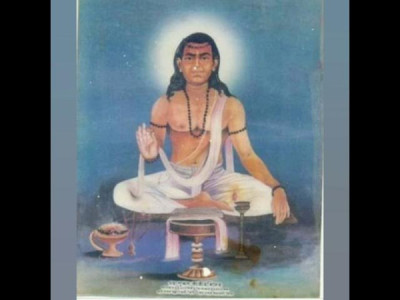
Life & Legacy
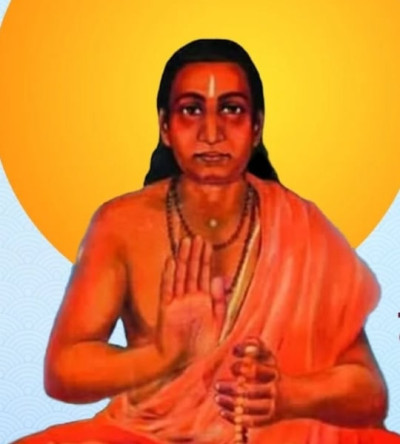
Srimanta Sankardeva was born in 1449 at Alipukhuri, Bordowa in present-day Nagaon district of Assam. He was born into the Shiromani Bhuyan family to Kusumvar Bhuyan and Satyasandhya Devi. After losing both parents during childhood, he was lovingly raised by his grandmother Khersuti, whose care and guidance greatly influenced his early life. Even as a young boy, Sankardeva displayed exceptional intelligence, creativity and leadership qualities that later defined his extraordinary journey.
Early Life
From childhood, Srimanta Sankardeva possessed an extraordinary thirst for knowledge. He received his early education under the renowned scholar Mahendra Kandali, where he quickly gained recognition for his remarkable memory, literary talent and intellectual abilities. According to traditional accounts, he composed his first verse while still a young student, demonstrating exceptional poetic skill.
Apart from academics, he excelled in physical activities, swimming, archery, wrestling and horse riding. His balanced development of intellectual, spiritual and physical abilities prepared him for the leadership role he would later assume in Assamese society.
Following the responsibilities of family life after marriage, Sankardeva gradually devoted himself to spiritual study, literature and the welfare of society. His desire to understand different religious traditions eventually inspired him to undertake an extensive pilgrimage across India.
Education and Pilgrimage
Srimanta Sankardeva received his formal education at the traditional Tol under Mahendra Kandali, where he mastered Sanskrit scriptures, philosophy, grammar and classical literature. His scholarly background enabled him to interpret religious texts in a manner that ordinary people could understand.
Around 1481, he began a long pilgrimage covering several important religious centres across India, including Puri, Mathura, Vrindavan, Prayagraj, Ayodhya, Kashi and Badrinath. During this journey he observed different religious practices, interacted with saints and scholars, and gained a deeper understanding of the Bhakti movement spreading throughout the country.
The pilgrimage profoundly influenced his spiritual thinking. Instead of promoting complex rituals, he concluded that sincere devotion to one Supreme God and moral living were the true paths to salvation. These experiences later became the philosophical foundation of Ekasarana Dharma.
Founder of Ekasarana Dharma
One of Srimanta Sankardeva's greatest achievements was the establishment of Ekasarana Dharma, also known as Mahapurushiya Dharma. This Neo-Vaishnavite movement centred on complete devotion to Lord Krishna as the Supreme Being and encouraged people to seek spiritual liberation through faith, prayer and righteous conduct.
His teachings rejected unnecessary rituals, caste discrimination and social inequality. Instead, he promoted equality, compassion, honesty and devotion that welcomed people from all sections of society regardless of caste, community or social background.
The four pillars of Ekasarana Dharma are:
- Deva (Lord Krishna as the Supreme God)
- Guru (Spiritual Guide)
- Naam (Chanting the Holy Name)
- Bhakat (Community of Devotees)
These principles continue to guide millions of followers throughout Assam and neighbouring regions.
Social and Religious Reforms
Srimanta Sankardeva introduced a far-reaching social and religious reform movement that transformed Assamese society. At a time when caste divisions and ritualistic practices dominated religious life, he preached equality, simplicity and universal brotherhood.
His movement welcomed people belonging to different tribes, castes and communities into a common spiritual fold. Through his teachings, he promoted peaceful coexistence and mutual respect among diverse ethnic groups living in Assam.
He strongly encouraged moral values, truthfulness, compassion and selfless service. Instead of expensive rituals, he advocated collective prayer, devotional singing and community participation as the true expressions of faith.
His reform movement helped strengthen social unity and created a shared cultural identity that continues to influence Assamese society even today.
Establishment of Namghars and Satras
Among Srimanta Sankardeva's most enduring contributions was the establishment of Namghars and Satras, institutions that became the foundation of Assamese religious and cultural life.
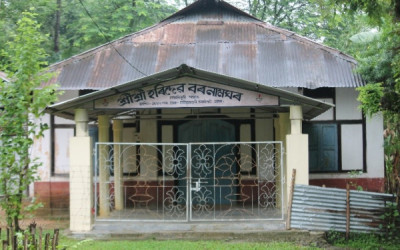
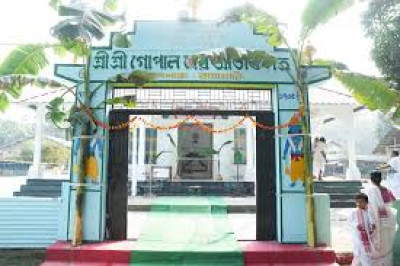
Namghars were community prayer halls where people gathered to sing devotional hymns, listen to religious discourses and participate in social activities. These institutions promoted equality by allowing people from different backgrounds to worship together without discrimination.
Satras were Vaishnavite monasteries established for preserving religious teachings, literature, music, dance, manuscript writing and cultural traditions. Over time, Satras became important centres of education, spiritual learning and artistic excellence throughout Assam.
Even today, thousands of Namghars and Satras continue to preserve the ideals of Srimanta Sankardeva while playing an important role in maintaining Assam's rich cultural heritage.
Contributions to Assamese Literature
Srimanta Sankardeva is regarded as one of the greatest literary figures in Assamese history. He transformed devotional literature by presenting profound spiritual ideas in a language that ordinary people could easily understand.
His writings combined philosophy, devotion, poetry and storytelling, making sacred knowledge accessible to the masses. He translated important portions of the Bhagavata Purana into a language familiar to the people and composed devotional works that remain central to Assamese religious life.
His literary creations significantly enriched Assamese language and established a strong foundation for future generations of writers and scholars.
Contributions to Music, Dance and Theatre
The cultural influence of Srimanta Sankardeva extends across every major performing art in Assam. He composed devotional songs known as Borgeets, which remain among the most respected forms of Assamese spiritual music. These compositions are still performed in Namghars, Satras and religious festivals across the state.
He also introduced Ankiya Naat, a unique form of one-act devotional drama that combines storytelling, music, dance and philosophy. These plays are traditionally performed as Bhaona, a theatrical tradition that continues to thrive in Assamese culture.
Perhaps his greatest artistic contribution was the creation and development of Sattriya, a classical dance tradition originally performed within Satras as an expression of devotion. Today, Sattriya is recognised as one of the eight classical dance forms of India and is performed on national and international stages.
Through literature, music, dance and theatre, Srimanta Sankardeva created a comprehensive cultural movement that continues to define the spiritual and artistic identity of Assam.
Major Literary Works
Srimanta Sankardeva made unparalleled contributions to Assamese literature through devotional poetry, philosophical writings, translations and dramatic compositions. His works simplified complex religious concepts and made them accessible to ordinary people. Written primarily in Assamese and Brajavali, his literary creations continue to be recited, studied and performed throughout Assam.
Some of his most important literary works include:
- Kirtana Ghosha
- Gunamala
- Bhakti Pradipa
- Nimi Nava Siddha Samvada
- Harischandra Upakhyana
- Rukmini Harana Kavya
- Ajamil Upakhyana
- Bali Chhalana
- Kurukshetra
- Gopi Uddhava Samvada
- Uttara Kanda (Ramayana)
- Bhagavata Purana (Selected Books)
Kirtana Ghosha
Kirtana Ghosha is regarded as the greatest literary achievement of Srimanta Sankardeva. It is a collection of devotional hymns based on the Bhagavata Purana and forms one of the most sacred religious texts of Assamese Neo-Vaishnavism. Even today, it is recited daily in Namghars and Satras across Assam and serves as an important guide for devotional worship.
Gunamala
Gunamala is another masterpiece of Sankardeva. According to tradition, he composed this remarkable work in a single night. The book presents the essence of the Bhagavata Purana in a concise and easily understandable form, allowing devotees to grasp its spiritual teachings without reading the entire scripture.
Bhakti Pradipa
Bhakti Pradipa explains the philosophy of devotion to Lord Krishna and emphasizes sincere faith over ritualistic practices. The work highlights the importance of moral living, humility and complete surrender to God.
Bhagavata Translation
One of Sankardeva's greatest scholarly achievements was translating several books of the Bhagavata Purana into a language understood by common people. His translations made sacred knowledge accessible beyond scholars and significantly strengthened Assamese literature.
Ankiya Naat (One-Act Plays)
Srimanta Sankardeva introduced Ankiya Naat, a unique theatrical tradition that blended devotion, music, dance and storytelling. These plays were designed to educate people through entertaining performances and remain an important part of Assamese cultural heritage.
His major Ankiya Naat plays include:
- Chihna Yatra (considered the earliest Assamese play)
- Patni Prasada
- Kaliya Damana
- Rukmini Harana
- Parijata Harana
- Keli Gopala
- Sri Rama Vijaya
These dramas are traditionally performed as Bhaona, which continues to be one of Assam's most respected theatrical traditions.
Borgeets
Srimanta Sankardeva composed approximately 240 Borgeets, although only a limited number have survived over the centuries. These devotional songs are based on classical ragas and express deep spiritual devotion to Lord Krishna.
Borgeets remain an integral part of Assamese religious ceremonies and continue to be performed in Namghars, Satras and cultural festivals throughout the state.
Major Achievements
Srimanta Sankardeva's contributions transformed the religious, literary and cultural landscape of Assam. His achievements continue to influence millions of people even after more than five centuries.
His major achievements include:
- Founder of Ekasarana Dharma (Neo-Vaishnavism in Assam).
- One of the greatest saints of the Indian Bhakti Movement.
- Established the Namghar system of community worship.
- Founded the Satra institution for preserving religion, education and culture.
- Revitalised Assamese literature through devotional writings.
- Composed the sacred text Kirtana Ghosha.
- Authored the philosophical work Gunamala.
- Translated important portions of the Bhagavata Purana.
- Created the tradition of Borgeets.
- Introduced Ankiya Naat, a distinctive Assamese theatre form.
- Laid the foundation of Bhaona performances.
- Developed Sattriya, now recognised as one of India's classical dance forms.
- Promoted social equality by rejecting caste discrimination.
- Encouraged communal harmony among diverse ethnic communities.
- Preserved and enriched Assamese language and culture.
Awards and Recognition
During the fifteenth and sixteenth centuries, formal government awards did not exist in the modern sense. However, Srimanta Sankardeva received immense respect and recognition from his followers, scholars and rulers because of his extraordinary contributions.
Today, his legacy is honoured in numerous ways:
- Revered as Mahapurush, meaning "Great Soul."
- Recognised as the founder of Assamese Neo-Vaishnavism.
- Sattriya dance, developed through his movement, is recognised as one of the Classical Dance Forms of India.
- The Srimanta Sankaradeva Kalakshetra in Guwahati commemorates his cultural contributions.
- The Srimanta Sankaradeva Sangha continues to spread his teachings.
- Hundreds of Satras and thousands of Namghars across Assam preserve his spiritual and cultural heritage.
- Universities, educational institutions and cultural organisations regularly conduct research on his philosophy and literary works.
Death
Srimanta Sankardeva passed away in 1568 at Bhela Danga near Koch Behar after dedicating nearly twelve decades of his life to religion, literature, social reform and cultural development. His passing marked the end of an extraordinary era, but his teachings continued through his foremost disciple Madhavdeva and countless followers.
Legacy
The legacy of Srimanta Sankardeva extends far beyond religion. He laid the foundation for a unified Assamese identity by integrating spirituality with literature, music, theatre, dance and community life.
His institutions, including Namghars and Satras, continue to function as centres of worship, education and cultural preservation. His literary masterpieces remain among the most respected works in Assamese literature, while Borgeets, Bhaona and Sattriya continue to flourish across India and internationally.
Today, Srimanta Sankardeva is remembered as one of India's greatest saints, philosophers and cultural visionaries. His message of equality, devotion, compassion and universal brotherhood continues to inspire people across generations and remains deeply rooted in the cultural identity of Assam.
FAQs on Srimanta Sankardeva
1. Who was Srimanta Sankardeva?
Srimanta Sankardeva was a 15th-16th century saint, philosopher, poet, playwright, social reformer and cultural icon of Assam. He founded the Neo-Vaishnavite movement known as Ekasarana Dharma and transformed Assamese religion, literature, music, dance and theatre through his teachings and creative works.
2. When and where was Srimanta Sankardeva born?
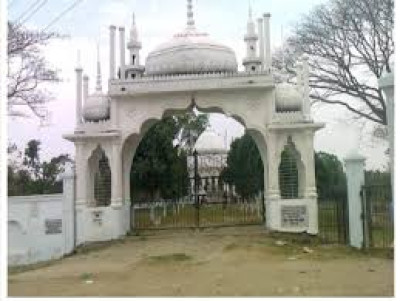
Srimanta Sankardeva was born in 1449 at Alipukhuri (Bordowa) in present-day Nagaon district, Assam, India. His birthplace is now one of the most important religious and cultural pilgrimage sites in Assam.
3. What is Ekasarana Dharma founded by Srimanta Sankardeva?
Ekasarana Dharma, also known as Mahapurushiya Dharma, is a Neo-Vaishnavite faith established by Srimanta Sankardeva. It emphasizes complete devotion to Lord Krishna, chanting God's name (Naam), moral living, equality among all people and rejection of caste discrimination and unnecessary rituals.
4. What are the major contributions of Srimanta Sankardeva?
Srimanta Sankardeva founded Ekasarana Dharma, established Namghars and Satras, composed Kirtana Ghosha and Borgeets, introduced Ankiya Naat and Bhaona, developed Sattriya dance, translated portions of the Bhagavata Purana and played a vital role in shaping Assamese literature, religion and culture.
5. What are the famous books written by Srimanta Sankardeva?
Some of his most important literary works include Kirtana Ghosha, Gunamala, Bhakti Pradipa, Nimi Nava Siddha Samvada, Harischandra Upakhyana, Rukmini Harana, Ajamil Upakhyana, Bali Chhalana, Kurukshetra, Gopi Uddhava Samvada and translations of several books of the Bhagavata Purana.
6. What are Borgeets and why are they important?
Borgeets are classical devotional songs composed by Srimanta Sankardeva and later enriched by Madhavdeva. These spiritually significant compositions are based on traditional ragas and are still sung in Namghars, Satras and religious festivals throughout Assam.
7. What is Sattriya Dance and who created it?
Sattriya is one of the eight classical dance forms of India. It was introduced by Srimanta Sankardeva as a devotional dance tradition performed in Satras to accompany religious dramas and worship. Today, Sattriya is recognised internationally as an important Indian classical dance form.
8. What are Namghars and Satras established by Srimanta Sankardeva?
Namghars are community prayer halls established by Srimanta Sankardeva for congregational worship, devotional singing and social gatherings. Satras are Vaishnavite monasteries that preserve religious teachings, literature, music, dance, manuscripts and Assamese cultural traditions.
9. When did Srimanta Sankardeva die?
Srimanta Sankardeva passed away in 1568 at Bhela Danga near Koch Behar after dedicating his life to religion, literature, social reform and the cultural development of Assam. His teachings continue to influence millions of people across Northeast India.
10. Why is Srimanta Sankardeva important in the history of Assam?
Srimanta Sankardeva is regarded as one of the greatest architects of Assamese civilisation. Through his religious reforms, literary masterpieces, devotional music, theatre, dance and social philosophy, he united diverse communities and laid the foundation of Assam's cultural identity. His legacy continues to inspire scholars, artists, spiritual leaders and devotees across generations.