Detailed Notes
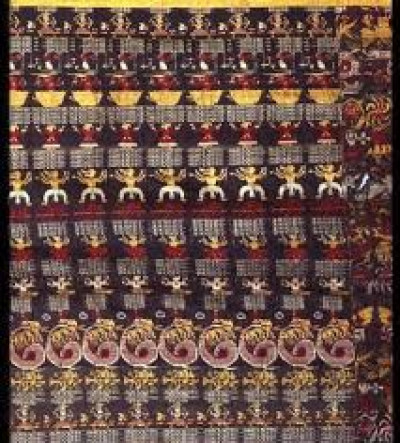
Commissioned by Koch king Naranarayana, the Vrindavani Vastra was woven by skilled Assamese artisans associated with the Sattriya cultural tradition. Instead of painting, complex stories from the Bhagavata Purana were transformed into woven visual narratives on silk. This made the Vastra a powerful tool for religious instruction at a time when large sections of society were not literate.
Originally, the Vrindavani Vastra consisted of multiple silk panels, estimated to be around fifteen or more. These individual sections were later stitched together to form a massive textile measuring nearly nine and a half metres in length. The weaving technique, precision of motifs, and symbolic storytelling reflect an advanced level of craftsmanship rarely seen even today.
Historically, the Vrindavani Vastra represents the integration of devotion, literature, performance, and textile art. Its iconography mirrors Sankardeva's teachings and the philosophy of Ek Saran Naam Dharma, which emphasised devotion to a single supreme deity, Lord Krishna. For this reason, the Vastra is often described as a visual scripture rather than a decorative fabric.
During the late medieval period, the Vrindavani Vastra gradually left Assam. Trade routes carried the textile through the Himalayan region to Tibet, from where European collectors acquired different fragments. By the early 20th century, major portions reached international museums. A significant piece entered the British Museum in 1904, while other fragments were preserved in museums in Paris, Boston, and Los Angeles.
Today, these institutions safeguard the Vrindavani Vastra using advanced conservation technology. However, the physical separation of the textile from its place of origin highlighted long-standing challenges in heritage preservation within Assam.
In a major recent development, the Government of Assam signed a Letter of Intent with the British Museum to bring the Vrindavani Vastra back to Assam on loan. The agreement proposes an 18-month exhibition in 2027, subject to strict conservation conditions. This initiative has renewed national and international attention on Assam's cultural heritage and the need for modern preservation infrastructure.
The Vrindavani Vastra continues to inspire Assam by connecting contemporary society with its spiritual past. It reflects Sankardeva's inclusive vision, the excellence of Assamese weavers, and the cultural strength of the region. For students and general knowledge learners, the topic is important due to its links with culture, heritage conservation, and India's global cultural relations.