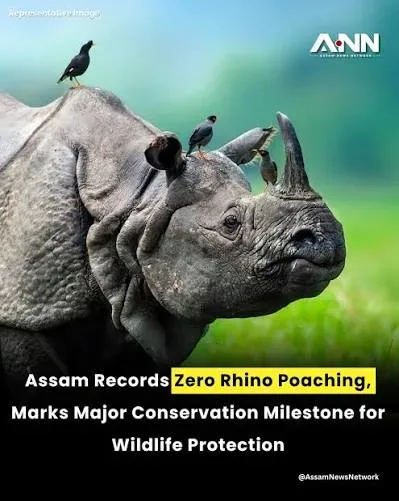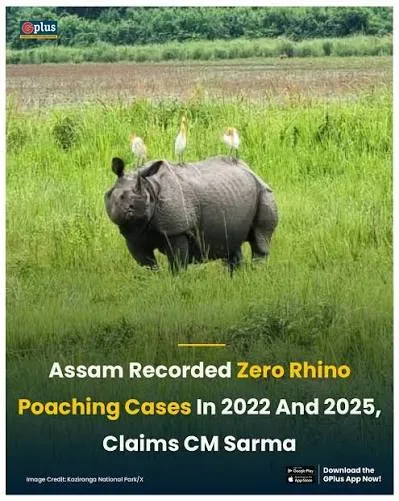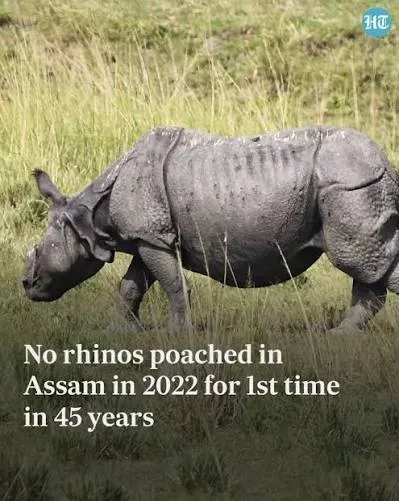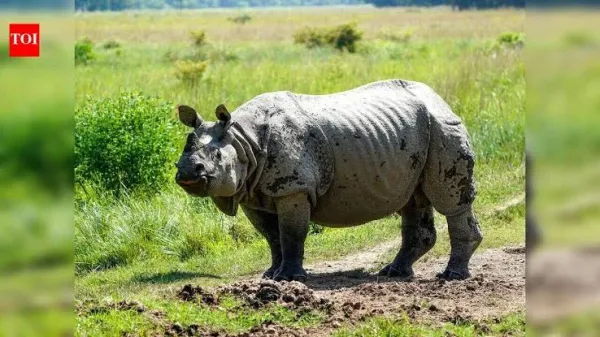
Assam has achieved a major milestone in rhinoceros conservation, with the state recording zero known rhino poaching incidents during 2025, according to the International Rhino Foundation's 2026 State of the Rhino report. The achievement was highlighted in September 2026 around World Rhino Day and marks only the second year since the 1970s in which Assam has recorded no known rhino poaching. The state had previously achieved the same milestone in 2022.
The development is particularly significant because Assam is the most important stronghold of the greater one-horned rhinoceros in the world. Current estimates cited in the 2026 conservation reporting put Assam's population at around 3,260 animals, close to 80% of the estimated global population of 4,075. Kaziranga National Park alone supports more than 2,600 greater one-horned rhinos.
Assam Rhino Conservation: Key Facts for Assam GK
For students preparing for APSC, ADRE, Assam Police, UPSC and other competitive examinations, the following points are important:
- Conservation milestone: Assam recorded zero known rhino poaching incidents in 2025.
- Previous zero-poaching year: 2022.
- Significance: 2025 was only the second such year since the 1970s.
- Rhino species: Greater one-horned rhinoceros (Rhinoceros unicornis).
- Assam rhino population: Approximately 3,260.
- Estimated global greater one-horned rhino population: Approximately 4,075.
- Assam's global share: Nearly 80% of the world's greater one-horned rhinos.
- Major stronghold: Kaziranga National Park.
- Kaziranga population: More than 2,600 rhinos.
- International source: International Rhino Foundation (IRF) 2026 State of the Rhino report.
- World Rhino Day: September 22.
- World Rhino Day 2026 theme: "Keep the Five Alive".
The 2026 State of the Rhino Report
The International Rhino Foundation publishes its annual State of the Rhino report to document population trends, conservation developments and major threats affecting the world's five surviving rhinoceros species.
The 2026 report estimates the worldwide greater one-horned rhino population at 4,075, compared with 4,014 in 2022. The broader report also notes that rhino conservation has made substantial progress in several areas while serious threats remain for some species.
For Assam, the most notable development is the absence of any known rhino poaching incident during 2025. This represents a major change from the period when rhino poaching was a serious threat to the state's wildlife.
Why Zero Rhino Poaching Is Important for Assam
The greater one-horned rhinoceros is one of the most recognisable symbols of Assam's wildlife heritage. The state contains the largest concentration of this species anywhere in the world, making effective protection in Assam important not only for India but also for global rhino conservation.
The 2025 zero-poaching record is especially notable when compared with the state's earlier history. During the mid-2010s, Assam experienced years in which rhino poaching reached very high levels. According to reporting on the state's conservation record, 27 rhinos were killed by poachers in both 2013 and 2014. Between 2000 and 2021, at least 191 rhinos were reported to have been poached in Assam.
The transition from those high-poaching years to a year with no known poaching incidents reflects a significant strengthening of wildlife protection measures.
How Assam Reduced Rhino Poaching
Assam's conservation progress has involved several layers of protection rather than relying on a single measure.
Intelligence-led enforcement has become an important part of the anti-poaching system. Forest officials and law-enforcement agencies have worked to identify suspected poachers and organised wildlife crime networks before they can target rhinos.
Coordination between the Forest Department and police agencies has also been strengthened. Assam has maintained specialised anti-poaching structures involving senior forest and police officials, with the state's Anti-Poaching Task Force expanded to cover rhinos and other wildlife species.
Surveillance technology has added another layer of protection. Patrolling and monitoring have been supported by drones, CCTV systems, communication equipment and other surveillance methods, particularly in areas where rhinos are concentrated.
Frontline forest personnel remain central to the protection system. Forest guards and specialised protection teams conduct regular patrols and monitor vulnerable areas inside and around protected landscapes.
Local communities also play an important role. People living near protected areas can provide information about suspicious activity and help conservation authorities monitor the wider landscape beyond park boundaries.
Assam's Rhino Conservation Journey
The 2025 result is better understood as part of a longer conservation journey rather than as an isolated achievement.
Assam previously recorded a year with zero known rhino poaching in 2022. However, one rhino was killed by poachers in 2023 and two were killed in 2024. The return to zero known incidents in 2025 therefore represents a renewed conservation milestone.
Authorities have also intensified operations against organised poaching networks. Earlier reporting noted arrests of individuals linked to poaching gangs and increased intelligence sharing between agencies.
The objective is not simply to react after a rhino has been killed. Modern conservation efforts increasingly focus on preventing poaching attempts through intelligence, surveillance, coordinated patrols and community-based information networks.
Kaziranga National Park: The Main Rhino Stronghold
Kaziranga National Park remains at the centre of Assam's rhino conservation story. It supports more than 2,600 greater one-horned rhinos and represents the largest concentration of the species globally.
The park's conservation model combines habitat management with intensive wildlife protection. Regular patrols, surveillance, intelligence gathering and monitoring of vulnerable areas are important components of the system.
However, Assam's rhino conservation is not limited to Kaziranga. Greater one-horned rhinos are also found in other protected areas, including Manas National Park, Orang National Park and Pobitora Wildlife Sanctuary.
From Poaching Control to Habitat Protection
Stopping poaching is one part of rhino conservation. As the population grows, maintaining sufficient and connected habitat becomes increasingly important.
Rhinos depend heavily on grasslands and wetland ecosystems for food and shelter. Changes in land use, habitat fragmentation, invasive vegetation, water availability and human activity can affect the quality of these habitats.
This means the next stage of conservation requires continued attention to habitat management as well as protection from illegal hunting.
The challenge is particularly relevant in Assam because a very large proportion of the world's greater one-horned rhino population is concentrated within a relatively small geographical area.
Indian Rhino Vision 2020
Indian Rhino Vision 2020 was an important conservation initiative aimed at increasing Assam's rhino population and establishing or strengthening populations across multiple protected areas.
The programme involved the Assam Forest Department, World Wide Fund for Nature-India, International Rhino Foundation and other conservation partners. One of its approaches was the translocation of rhinos between protected areas to help establish populations in suitable parts of their historical range.
The broader objective was to reduce the concentration of the species in a limited number of locations and create stronger, more distributed populations.
Key Challenges for Rhino Conservation in Assam
Despite the zero-poaching milestone, conservation work is not complete.
Habitat degradation can reduce the availability of suitable grasslands and wetlands. Invasive plant species can change grassland structure and affect the availability of natural food.
Flooding is another important factor in Assam. Seasonal floods are a natural part of the Brahmaputra and surrounding ecosystems, but extreme flooding can create risks for wildlife and increase movement outside protected areas.
Water availability during dry periods can also influence habitat suitability.
As rhino populations expand and animals move beyond protected boundaries, interaction with people can increase. Human-wildlife conflict therefore remains an issue that requires continued monitoring and appropriate management.
The conservation challenge has consequently shifted from only preventing poaching to protecting the wider landscape required for a growing rhino population.
World Rhino Day 2026 and Assam's Conservation Achievement
World Rhino Day is observed every year on September 22 to raise awareness about rhinoceros conservation and the threats facing the five surviving rhino species.
The International Rhino Foundation marks World Rhino Day as an international awareness day focused on all five species.
The 2026 theme was "Keep the Five Alive", highlighting the need to protect all five remaining rhinoceros species: the greater one-horned, black, white, Javan and Sumatran rhinos.
Assam's zero-poaching record received particular attention during World Rhino Day 2026 because of the state's role in protecting a major share of the global greater one-horned rhino population.
Assam's Role in Global Rhino Conservation
The importance of Assam extends beyond India's borders. With approximately 3,260 greater one-horned rhinos, the state holds close to 80% of the estimated global population of the species.
The global population of the greater one-horned rhino has increased from an estimated 4,014 in 2022 to around 4,075 in the latest IRF assessment. While this represents positive population growth, the species remains dependent on effective habitat protection and continued conservation action.
India and Nepal are particularly important range areas for the greater one-horned rhinoceros. The two countries have also reported significant progress in reducing rhino poaching.
Why Rhino Conservation Matters to Assam
The rhinoceros is deeply associated with Assam's natural identity and tourism. Kaziranga National Park, in particular, attracts visitors from India and around the world because of its wildlife, with the greater one-horned rhinoceros being one of its most recognisable species.
Rhinos also play an ecological role in grassland environments. Their movement and feeding behaviour can influence vegetation structure and contribute to the functioning of these ecosystems.
Protecting rhinos therefore involves more than saving an individual animal from poaching. It also means protecting grasslands, wetlands, forests, waterways and wildlife corridors that support a wider range of species.
Legal Protection of the Greater One-Horned Rhino
The greater one-horned rhinoceros receives strong legal protection in India. The species is listed under Schedule I of the Wild Life (Protection) Act, 1972, providing it with the highest level of protection under the country's wildlife law. International trade in rhino horn is also prohibited under the Convention on International Trade in Endangered Species of Wild Fauna and Flora (CITES).
These legal measures work alongside field-level enforcement, habitat management and conservation programmes.
Assam Rhino Conservation: Important Facts for Competitive Exams
For Assam GK and Current Affairs preparation, remember these important points:
- Assam recorded zero known rhino poaching incidents in 2025.
- The milestone was reported in the International Rhino Foundation's 2026 State of the Rhino report.
- It was only the second such year since the 1970s.
- Assam had previously recorded zero known rhino poaching in 2022.
- Assam has approximately 3,260 greater one-horned rhinos.
- The estimated global population of the species is around 4,075.
- Assam accounts for nearly 80% of the global greater one-horned rhino population.
- Kaziranga National Park has more than 2,600 rhinos.
- World Rhino Day is observed on September 22.
- The 2026 World Rhino Day theme was "Keep the Five Alive".
- Indian Rhino Vision 2020 focused on increasing and distributing rhino populations across suitable protected areas.
- The greater one-horned rhinoceros is protected under Schedule I of the Wild Life (Protection) Act, 1972.
Conclusion
Assam's record of zero known rhino poaching incidents in 2025 represents an important milestone in the state's long-running effort to protect the greater one-horned rhinoceros. The achievement is particularly significant because Assam supports nearly 80% of the world's population of this species.
The progress has been associated with stronger intelligence gathering, coordinated enforcement, surveillance, frontline protection and community participation. At the same time, conservation priorities are expanding beyond anti-poaching operations to include habitat quality, connectivity, flood management, invasive vegetation and human-wildlife interaction.
The 2026 State of the Rhino report provides an important current-affairs reference for Assam, while World Rhino Day 2026 has brought additional attention to the state's conservation efforts. For students preparing for Assam GK, APSC, ADRE, Assam Police and other competitive examinations, Assam's zero rhino-poaching record in 2025 is an important environmental and wildlife conservation development.