History & Traditions
Bhatheli Utsav – A Folk Festival Rooted in Nature, Agriculture and Community Life
Also known by regional names such as Paowra Tola, Sori, Suanri, Deul or Pawra, Bhatheli is deeply associated with agrarian traditions. At its core, the festival is a symbolic worship of the bamboo tree, revered as a representation of fertility, growth, strength and prosperity.
Agricultural and Seasonal Importance
Bhatheli Utsav marks the beginning of the spring sowing season, a crucial phase in Assam's agricultural calendar. Farmers believe that honoring nature at this moment ensures timely rainfall, protection from floods and a bountiful harvest. The festival reflects the intimate relationship between rural communities and the natural environment, particularly in riverine regions along the Barnadi and Manas rivers.
The bamboo pole planted during Bhatheli is seen as a living symbol of crop growth. Just as bamboo grows tall and resilient, villagers pray for their crops to flourish in the same manner throughout the year.
Ritual of Bamboo Worship
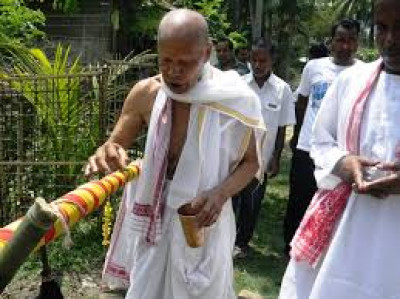
The most defining ritual of Bhatheli Utsav is the planting of decorated bamboo poles, locally known as Paara or Paowra. Early in the morning, village youths take purifying baths in nearby rivers or ponds before cutting long, straight bamboo stems from groves.
These bamboos are carefully cleaned, washed and adorned with colorful cloth, flowers, leaves, cowries and streamers. In many villages, two bamboos are erected, symbolically representing a bride and groom, while some regions also install a small hut made of banana leaves called Bhatheli Ghar near the poles.
The decorated bamboo is planted in an open field, near a banyan tree, or beside a sacred space. Prayers are offered to agricultural and nature deities, seeking protection from calamities and blessings for prosperity.
Symbolic Marriage and Folk Beliefs
One unique element of Bhatheli Utsav is the symbolic marriage ceremony performed around the bamboo poles. Villagers form a circle around the central pole, with participants playfully assigned roles as bride, groom and relatives. This ritual symbolizes fertility, continuity of life and harmony within the community.
In the Bajali region of Kamrup, the bamboo is placed against a banyan tree associated with Madan Mohan Gosain, a form of Lord Krishna. This reflects the blending of folk beliefs with Hindu traditions, a hallmark of Assamese culture.
Cultural Activities and Community Celebration
Bhatheli Utsav is a lively community event marked by folk songs, traditional dances and music played on instruments like dhol, khol and taal. Villagers of all ages participate, creating an atmosphere of joy and togetherness.
Children and youth play a significant role in the celebrations. Folk games, friendly competitions and open Bihu sessions are organized, especially in the evening, making the festival both entertaining and socially engaging.
Local fairs often accompany the festival, where traders sell handicrafts, agricultural tools, household items and traditional food, turning the occasion into an important social and economic gathering.
Historical Roots and Mythological Connections
Scholars believe that Bhatheli Utsav has origins in ancient fertility cults of Assam. Renowned Assamese scholar Banikanta Kakati pointed out strong similarities between Bhatheli and the Indradhwaja festival mentioned in the Kalika Purana, where tall poles were raised to worship Indra, the Vedic god of rain and prosperity.
Over centuries, these ancient practices evolved and merged with local customs, creating the present-day form of Bhatheli. Despite regional variations, the underlying theme of honoring nature and ensuring agricultural well-being has remained unchanged.
Regional Variations Across Assam
While Bhatheli is widely celebrated in North Kamrup, it appears under different names and customs in other areas:
-
In South Kamrup and Goalpara, it is known as Sori or Suanri
-
In Darrang, it is referred to as Deul
-
In Nalbari and Rangiya, the festival emphasizes youth participation, folk games and Bihu performances
Despite these variations, the bamboo worship ritual remains the central element everywhere.
Social Harmony and Inclusiveness
Bhatheli Utsav stands out as a festival that promotes unity beyond caste, religion and social status. People from diverse communities participate as organizers, performers, traders and visitors. In many villages, individuals from different religious backgrounds join the celebrations, reinforcing mutual respect and peaceful coexistence.
This inclusive nature has allowed Bhatheli to survive and thrive across generations, passing cultural values to younger members of society.
Bhatheli in Contemporary Times
In modern Assam, Bhatheli Utsav continues to be celebrated with renewed enthusiasm. Cultural organizations and local communities actively work to preserve the festival through folk performances, documentation and public celebrations. While the core rituals remain traditional, the festival has adapted to contemporary settings without losing its original essence.
Conclusion
Bhatheli Utsav is not merely a folk festival but a reflection of Assam's agrarian soul. Through bamboo worship, communal rituals, music and shared joy, the festival celebrates nature, life and unity. Deeply rooted in history yet alive in the present, Bhatheli remains a powerful symbol of Assamese cultural heritage and rural resilience.