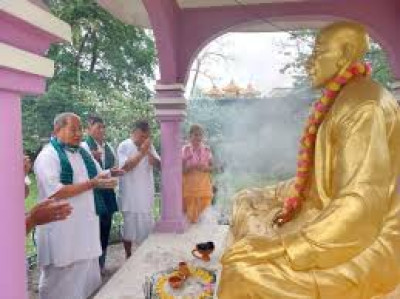
Life & Legacy
Originally known as Kalicharan Mech, he was born into a relatively prosperous family. His father, Kaulram Mech, was a timber merchant, which allowed young Kalicharan access to early education. Though financial and personal circumstances limited his formal schooling, he developed strong intellectual curiosity and moral conviction from an early age. These qualities later shaped his reformist outlook and leadership.
During the late nineteenth and early twentieth centuries, Bodo society faced multiple challenges. Social evils such as excessive consumption of rice beer, animal sacrifices, illiteracy, and rigid customary practices weakened community unity. External religious conversions and cultural assimilation further intensified the identity crisis among the Bodos. Kalicharan Brahma recognized that meaningful reform required both spiritual awakening and social restructuring.
In the early 1900s, he encountered reformist religious literature associated with the Brahmo movement. Deeply influenced by the idea of monotheism and rational worship, he traveled to Calcutta and embraced Brahmo principles in 1906. After initiation, he adapted these teachings into a localized spiritual movement known as Brahma Dharma. This new faith emphasized belief in one formless God symbolized by fire, truthfulness, moral discipline, and rejection of superstition. From that point onward, he became widely known as Gurudev Kalicharan Brahma.
The foundation of Brahma Dharma marked a turning point in Bodo religious history. He discouraged idol worship, animal sacrifice, and ritual intoxication, advocating instead for ethical living and spiritual purity. His teachings emphasized that social reform could not succeed without moral transformation. Fire worship in Brahma Dharma symbolized purity, energy, and universal truth. For Kalicharan Brahma, spirituality and social progress were inseparable.
Beyond religious reform, he actively promoted education as the primary tool for empowerment. He encouraged both boys and girls to attend school at a time when female education was uncommon. He supported the establishment of educational institutions and student organizations that later evolved into significant Bodo socio-cultural bodies. One of his notable contributions was inspiring the formation of Bodo student movements that nurtured political awareness and intellectual growth among youth.
He also worked to improve the economic condition of the community. He promoted weaving, agriculture, and small-scale economic initiatives to reduce dependency and encourage self-reliance. By organizing community conferences and village meetings, he mobilized people to adopt disciplined lifestyles and collective responsibility.
Language and cultural preservation were central to his mission. He believed that without safeguarding the Bodo language and traditional identity, genuine progress would remain incomplete. Through literary encouragement and social gatherings, he stimulated pride in Bodo heritage. His efforts laid the foundation for later cultural and literary movements that strengthened Bodo identity in Assam.
Politically, Gurudev Kalicharan Brahma demonstrated foresight. During the colonial period, he and his associates submitted memorandums to British authorities demanding representation and protection for indigenous communities. His engagement was not confrontational but strategic. He believed that organized representation, education, and unity were essential for safeguarding rights.
Despite facing opposition from traditional religious leaders and conservative elements, he remained steadfast. His reforms were sometimes criticized for modifying traditional practices. However, his supporters argue that his efforts prevented cultural erosion and social stagnation at a crucial historical juncture.
He passed away on 8 May 1938, leaving behind a powerful legacy. Today, his birth anniversary on 18 April is commemorated across Assam, especially within the Bodo community. He is remembered not only as a religious guide but also as a symbol of social awakening and indigenous pride.
Awards and Recognition
The Government of Assam instituted the Kalicharan Brahma Award to honor individuals contributing to social work, education, and cultural preservation. Various trusts and organizations also celebrate his legacy annually through lectures, community programs, and award ceremonies. His title Mech Gandhi of Assam reflects his commitment to non-violence, moral reform, and grassroots mobilization.
Legacy in Modern Assam
The influence of Gurudev Kalicharan Brahma extends beyond religious reform. His work inspired subsequent socio-political movements that shaped modern Bodo identity and administrative recognition. Educational institutions, community halls, and organizations across Assam bear his name, symbolizing enduring respect.
In contemporary discourse on indigenous rights and cultural preservation, his philosophy remains relevant. His approach combined spiritual reform, rational thinking, and community organization. By integrating faith with social responsibility, he demonstrated how internal reform can empower marginalized communities.
Search trends frequently highlight queries such as Gurudev Kalicharan Brahma biography, Mech Gandhi of Assam, founder of Brahma Dharma, Bodo social reformer of Assam, and Kalicharan Brahma contributions. His enduring digital presence reflects continued public interest in his life and mission.
Gurudev Kalicharan Brahma stands as a cornerstone figure in Assam history. His reforms addressed moral decline, promoted education, strengthened identity, and encouraged political awareness. His life story represents resilience, vision, and transformation rooted in cultural pride and ethical conviction.
FAQs on Gurudev Kalicharan Brahma