Mithun Festival 2026 in Assam: Celebrating the Pride of Dima Hasao
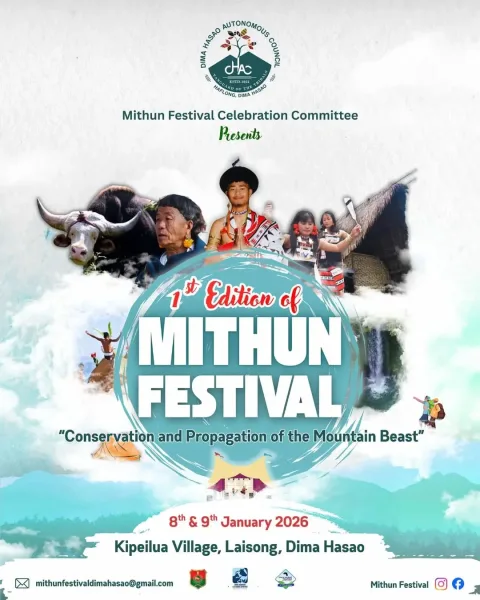
The first-ever Mithun Festival 2026 was celebrated on January 8 and 9, 2026, at Kipeilua Village in the Laisong area of Dima Hasao district, Assam. The two-day event brought together indigenous traditions, local communities, cultural performances and conservation awareness to celebrate the majestic Mithun, one of the most significant animals associated with the hill communities of Northeast India.
Organised by the Dima Hasao Autonomous Council (DHAC), in collaboration with the Animal Husbandry and Veterinary, Forest and Tourism Departments, the festival highlighted the cultural, ecological and economic importance of Mithun. The participation of the ICAR-National Research Centre on Mithun further connected traditional knowledge with scientific research and sustainable livestock development.
With the theme "Conservation and Propagation of Mithun", the inaugural festival aimed to promote awareness about this unique mountain animal while creating opportunities for local farmers, cultural groups and tourism-related communities.
Mithun Festival 2026: Quick Information
| Particulars | Details |
|---|---|
| Festival Name | Mithun Festival 2026 |
| Edition | First Edition |
| Dates | January 8–9, 2026 |
| Venue | Kipeilua (Kepeilo) Village |
| Location | Laisong area, Dima Hasao, Assam |
| Organiser | Dima Hasao Autonomous Council (DHAC) |
| Collaborating Departments | Animal Husbandry & Veterinary, Forest and Tourism Departments |
| Scientific Institution | ICAR-National Research Centre on Mithun |
| Main Theme | Conservation and Propagation of Mithun |
| Main Attraction | Mithun conservation, indigenous culture and traditional performances |
| Entry Fee | Free entry was announced for the inaugural edition |
| Contact | +91 86382 34439 |
What Is the Mithun Festival?
The Mithun Festival is a cultural and conservation-focused celebration dedicated to the Mithun, scientifically known as Bos frontalis. Often described as the cattle of the mountains, this large, semi-domesticated bovine is traditionally reared in the forested and hilly landscapes of Northeast India.
For several indigenous communities, the Mithun is much more than a source of livestock or agricultural value. It represents prosperity, social status, traditional wealth, cultural identity and the relationship between people and their natural surroundings.
In Dima Hasao, the animal holds particular importance among hill communities, including the Zeme Naga people. Its role in traditional customs, community life and local livelihoods makes its conservation an important part of preserving the region's heritage.
The festival was created as a platform to bring this traditional significance into wider public attention. It also provided an opportunity to discuss scientific breeding practices, habitat protection, sustainable rearing and ways to improve the livelihoods of families involved in Mithun farming.
Mithun Festival 2026: Dates and Venue
The inaugural edition of Mithun Festival was held on January 8 and 9, 2026, at Kipeilua Village, also referred to as Kepeilo, in the Laisong area of Dima Hasao district.
Located amid the green hills and rural landscapes of Dima Hasao, Kipeilua offered a distinctive setting for an event focused on indigenous livestock, traditional knowledge and community-based tourism.
The two-day programme brought together local residents, cultural performers, visitors, government representatives and experts associated with Mithun research and conservation.
The festival was formally inaugurated by Shri Debolal Gorlosa, Chief Executive Member of the Dima Hasao Autonomous Council. Council representatives and officials from participating departments also attended the inaugural programme.
Major Highlights of Mithun Festival 2026
The first edition combined cultural celebrations with discussions and activities focused on protecting the Mithun and supporting traditional livelihoods.
1. Celebrating Mithun and Its Cultural Importance
The Mithun was the central attraction of the festival. Visitors had an opportunity to understand why this animal holds such a special place in the traditions and everyday lives of Northeast India's hill communities.
For generations, Mithun has been associated with prosperity, traditional wealth, community relationships and important social customs. The festival provided a platform to introduce this heritage to a wider audience and encourage younger generations to appreciate its significance.
2. Conservation and Scientific Awareness
One of the major objectives was to promote the conservation and propagation of Mithun. The involvement of the ICAR-National Research Centre on Mithun brought scientific knowledge and research into the celebration.
Exhibits and awareness activities highlighted Mithun-based products, livestock management, sustainable farming, breeding practices and opportunities for improving rural livelihoods.
The discussions also emphasised the importance of protecting the natural environment in which Mithun is traditionally reared. Combining scientific guidance with the experience of local farmers can help strengthen conservation efforts and support sustainable livestock development.
3. Traditional Music and Folk Performances
The festival celebrated the cultural diversity of Dima Hasao through traditional music, folk performances and community participation.
Local artists and cultural groups presented performances that reflected the region's indigenous traditions. These programmes offered visitors an opportunity to experience the music, dance and artistic expressions of the hill communities.
4. Traditional Food and Local Stalls
Food was another important part of the celebration. Local stalls showcased traditional dishes and ethnic cuisine prepared by community members.
Visitors could explore regional flavours and learn about the food traditions of the area's indigenous communities. Such stalls also provided an opportunity for local food producers and small vendors to connect with visitors.
5. Evening Entertainment and DJ Performances
Alongside the traditional cultural programme, the festival included contemporary entertainment. Music performances and DJ sessions brought a lively atmosphere to the event grounds during the evening.
This combination of traditional celebrations and modern entertainment helped make the festival appealing to different age groups.
Why Is Mithun Important to the Hill Communities of Northeast India?
Mithun has a special place in the cultural and economic life of several communities across Northeast India. It is traditionally reared in forested hill environments and is closely connected with local customs, social relationships and indigenous knowledge.
Its importance can be understood through several aspects:
Cultural identity: Mithun is an important symbol of heritage and traditional life among many hill communities.
Traditional wealth: The animal has historically represented prosperity and social standing.
Community customs: Mithun is associated with traditional ceremonies, customary exchanges and important social occasions in some communities.
Rural livelihood: Mithun rearing can contribute to household income and local economic activity.
Biodiversity: Protecting Mithun and its natural habitat supports the conservation of an important indigenous livestock resource.
The festival's focus on conservation and propagation was therefore not limited to protecting an animal. It was also about safeguarding traditional knowledge, supporting rural communities and maintaining the cultural relationship between people, livestock and the surrounding environment.
Why the Mithun Festival Is Important for Assam Tourism
Dima Hasao is known for its hills, forests, valleys, indigenous cultures and scenic destinations such as Haflong, Jatinga and Maibang. The Mithun Festival adds another dimension to the district's tourism potential by bringing attention to its living cultural traditions.
Unlike conventional tourism events that focus mainly on entertainment, the festival connects visitors with the region's indigenous heritage and environmental concerns.
It also creates opportunities for:
Promoting lesser-known villages such as Kipeilua and Laisong.
Encouraging responsible cultural tourism.
Supporting local homestays, food vendors and artisans.
Introducing visitors to indigenous livestock and traditional farming.
Creating awareness about biodiversity and sustainable rural livelihoods.
Providing a platform for local artists and cultural groups.
Community-led festivals can help distribute tourism benefits beyond popular destinations and encourage visitors to explore lesser-known parts of Assam respectfully.
How to Reach Kipeilua Village, Laisong, Dima Hasao
Kipeilua Village is located in the Laisong area of Dima Hasao district. Visitors travelling from outside the district can generally use Haflong as their main transit and accommodation base before continuing towards Laisong.
By Road: Haflong is the main district hub and a useful starting point for road travel towards Laisong and Kipeilua. Visitors should check the latest road conditions and local transport availability before beginning the journey, as travel times can vary depending on the route and weather.
By Train: Haflong is connected by rail through the Lumding-Silchar railway route. Visitors can travel to the nearest convenient railway station and arrange onward road transport.
By Air: The nearest practical airport for many visitors is Silchar Airport. From Silchar, travellers can continue towards Haflong and then proceed to Laisong by road. Visitors travelling from Guwahati can also plan a road or rail journey towards Haflong.
Travel Tip: Kipeilua is an off-beat village destination. Arrange local transport in advance, particularly if travelling with family or carrying luggage. Confirm the current condition of the road to the village before departure.
Where to Stay Near Kipeilua and Laisong?
Kipeilua is a rural destination, so visitors should not expect the same range of hotels available in larger towns. Haflong is the most practical base for finding hotels, lodges and guest houses, while village homestays and community-based accommodation may be available closer to the festival location.
Below are some accommodation options in and around Haflong and the Laisong area.
Accommodation in and Around Haflong
1. Haflong Tourist Lodge
Address: Dibarai / Sainza Razi, Haflong, Assam - 788819
Contact: +91 96787 44347 (Haflong Tourist Information Office)
Alternative tourism contact: +91 69007 22908 (Dima Hasao Tourism Office)
2. Nothao Lodge
Address: Dibarai, near Ruina Gas Services, PWD 1st Colony, Haflong, Dima Hasao, Assam - 788819
Phone: +91 94354 48680
3. Landmark Hotel
Address: Member's Council Hostel Road East, Haflong Bazar, opposite D. B. School, Haflong, Assam - 788819
Phone: +91 3673 239009 / +91 60016 55397
4. Sharma Residency / Disgao Lodge / Lake View Lodge
Address: Disgao Razi, Convent Road, near PHE Pani Tenky, Haflong, Assam - 788820
Phone: +91 84535 99367
5. Lake View Lodge
Address: Main Road, Hagjer Nagar, near Haflong Lake, Haflong, Assam - 788819
Phone: +91 124 620 1318
6. S.W. Hading Guest House
Address: Near I Love Dima Hasao View Point (Shivarai Hading), Boro Haflong, Haflong, Assam - 788819
Phone: +91 93956 90686 / +91 93652 11152
7. BarGsaign Residency
Address: Sainza Razi, PC Langthasa Road, Haflong East, Haflong, Assam - 788819
Phone: +91 86381 24060
8. Naorai Kho Hotel
Address: Gadain Raji, behind Dima Hasao Autonomous Council, Haflong Bazar, Haflong East, Assam - 788819
Phone: +91 76360 76398
9. Jasleena Home Stay Haflong
Address: New Kunjung Village Road, Dibarai, Haflong, Assam - 788819
Phone: +91 80111 49917 / +91 80115 66009
10. Hills Hotel
Address: Shop No. 07, near Tata Agency, Kalibari Bazar / Kanabasti, Haflong, Assam
Village Homestays Near the Festival Area
For visitors who prefer a closer connection with local communities, village accommodation may be worth exploring.
Ningalakle Newme
Address: Kepeilo, Laisang Bagan, North Cachar Hills, Haflong, Assam - 788830
Singson Rural Homestay
Address: N. Leikul, Jatinga Valley Development Block, Haflong, Dima Hasao, Assam - 788830
Host: Nemhat Singson
Phone: +91 84728 14322 / +91 88008 42084 / +91 73996 66688
Local tourism operators and community coordinators may also be able to arrange village stays or small-group itineraries around Laisong. Living Roots Expeditions and other regional travel groups can be approached to enquire about possible arrangements.
Important accommodation note: The above properties and contact numbers are provided as travel references. Their current operating status, room availability, tariffs and booking arrangements should be confirmed directly before travelling. Village accommodation near Kipeilua may be limited, so advance planning is recommended.
Travel Tips for Visiting Kipeilua and Laisong
If you plan to visit Kipeilua or attend a future edition of the Mithun Festival, keep these practical suggestions in mind:
Carry warm clothing: Dima Hasao's higher-altitude areas can become very cold, especially during winter evenings and early mornings. Pack thermals, jackets and suitable footwear.
Plan your journey in advance: Arrange transport from Haflong to Laisong before starting the trip.
Book accommodation early: Room availability in and around smaller villages can be limited during festivals.
Respect local traditions: Ask permission before photographing residents, elders or cultural activities.
Support local communities: Try traditional food, purchase locally made handicrafts and consider staying in community-run accommodation.
Keep the surroundings clean: Avoid littering and reduce the use of single-use plastic.
Check local updates: Confirm festival dates, venue arrangements and road conditions through the organisers or local tourism authorities before travelling.
A New Cultural Festival for Dima Hasao
The inaugural Mithun Festival 2026 marked an important step in bringing the indigenous heritage of Dima Hasao to a wider audience. By placing the Mithun at the centre of a public celebration, the event highlighted the relationship between biodiversity, traditional knowledge, rural livelihoods and cultural identity.
The festival also demonstrated how local traditions can become a meaningful part of Assam's tourism landscape. Its combination of conservation awareness, scientific participation, traditional performances, ethnic food and community involvement created a distinctive cultural experience.
As Dima Hasao continues to develop its tourism potential, the Mithun Festival offers an opportunity to promote lesser-known destinations such as Kipeilua and Laisong while encouraging the preservation of the region's natural and cultural heritage.
For travellers interested in indigenous culture, rural experiences and the natural beauty of Assam's hill districts, the Mithun Festival is an event worth keeping an eye on in future editions.
Frequently Asked Questions About Mithun Festival 2026
1. When was Mithun Festival 2026 celebrated?
The first edition of Mithun Festival was held on January 8 and 9, 2026, as a two-day event in Dima Hasao district, Assam.
2. Where was Mithun Festival 2026 organised?
The festival took place at Kipeilua Village, also known as Kepeilo, in the Laisong area of Dima Hasao, Assam.
3. Who organised the first Mithun Festival in Assam?
The Dima Hasao Autonomous Council (DHAC) organised the festival in collaboration with the Animal Husbandry and Veterinary, Forest and Tourism Departments, with participation from the ICAR-National Research Centre on Mithun.
4. What was the theme of Mithun Festival 2026?
The central theme was "Conservation and Propagation of Mithun", highlighting the importance of protecting this indigenous mountain animal and supporting sustainable rearing practices.
5. What is Mithun and what is its scientific name?
Mithun is a large, semi-domesticated bovine traditionally found in parts of Northeast India. Its scientific name is Bos frontalis. It is also commonly known as the cattle of the mountains.
6. Why is Mithun important to the people of Dima Hasao?
Mithun represents traditional wealth, prosperity, cultural identity and social importance among several indigenous hill communities. It also contributes to rural livelihoods through traditional livestock rearing.
7. What were the main attractions of Mithun Festival 2026?
Major attractions included Mithun conservation exhibits, scientific awareness activities, traditional music, folk performances, local food stalls and evening entertainment featuring music and DJ sessions.
8. Was entry to Mithun Festival 2026 free?
Yes, free entry was announced for visitors attending the inaugural edition held on January 8–9, 2026.
9. Where can visitors stay when travelling to Kipeilua for the Mithun Festival?
Haflong offers several accommodation options, including tourist lodges, hotels, guest houses and homestays. Visitors can also enquire about village accommodation near Laisong through local tourism operators and community coordinators.
10. How can visitors reach Kipeilua Village from Haflong?
Visitors can travel by road from Haflong towards the Laisong area. It is advisable to arrange local transport in advance and confirm current road conditions before starting the journey.
Publishing Note: The first edition took place on January 8–9, 2026. The article is written as a retrospective feature, not as an announcement of confirmed dates for a 2027 edition. Accommodation contacts and travel arrangements should be verified before publication or use by visitors.