Introduction: A Land Shaped by Tectonic Forces
Assam, located in Northeast India, is one of the most earthquake-prone regions in the country. Its unique geological setting places it in a high seismic risk zone, making earthquakes a frequent natural phenomenon. Understanding the tectonic structure of Assam is essential to grasp why the region experiences such intense seismic activity.
Tectonic Setting: Where Plates Collide
The primary reason behind Assam's high earthquake risk lies in its position at the junction of multiple tectonic plates. The Indian Plate is continuously moving northward and colliding with the Eurasian Plate, forming the Himalayan mountain range. At the same time, the Indian Plate interacts with the Burmese Plate in the east.
This complex interaction creates immense pressure beneath the Earth's crust, leading to frequent earthquakes. Upper Assam represents the northeastern edge of the Indian continental plate, sandwiched between the Himalayan orogen in the northwest and the Assam-Arakan orogen in the southeast.
Seismic Zonation: Why Assam Falls in the Highest Risk Category
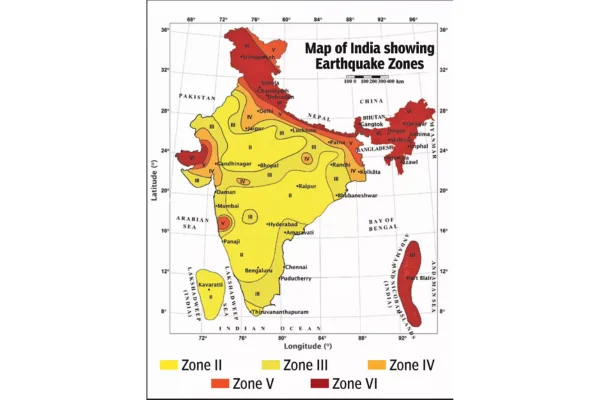
According to the latest seismic zonation under the Earthquake Design Code 2025, Assam has been placed in Zone VI, the highest earthquake-risk category in India. This updated classification reflects advanced scientific understanding of ground movement and tectonic activity.
Being in Zone VI does not indicate an immediate disaster but highlights the region's long-standing vulnerability to strong ground shaking. The classification plays a crucial role in urban planning, infrastructure development, and building safety regulations.
Active Fault Lines and Geological Features
Assam's seismic vulnerability is further increased by the presence of multiple active fault lines. Important fault systems in the region include the Dudhnoi Fault, Dhubri Fault, and the Eastern Himalayan Syntaxis.
The Shillong Plateau is another critical geological feature, known for its "pop-up" tectonic structure, which contributes to vertical movements during earthquakes. In contrast, the Assam Valley is dominated by transverse faults, resulting in both shallow and deep earthquakes.
Additionally, regions like the Tidding-Tuting Suture Zone are closely monitored for tectonic activity due to their potential to generate seismic events.
History of Major Earthquakes in Assam
Assam has experienced some of the most powerful earthquakes in recorded history. The 1897 earthquake, with a magnitude of 8.2, and the 1950 earthquake, measuring 8.6, are among the most significant seismic events in the region.
These earthquakes caused widespread destruction, landslides, and changes in the landscape, highlighting the immense power of tectonic forces in the region. Such historical events emphasize the need for continuous preparedness.
Environmental Impact and Secondary Hazards
Earthquakes in Assam often trigger secondary hazards such as landslides and soil liquefaction. The hilly terrain and heavy rainfall increase the risk of slope failures, while the alluvial soil of the Brahmaputra Valley is highly susceptible to ground shaking.
These factors make earthquakes not just a geological concern but also a significant environmental and infrastructural challenge.
Modern Monitoring and Scientific Advancements
India has strengthened its earthquake monitoring systems through the National Seismological Network, which tracks seismic activity across the country. Continuous monitoring of fault lines and tectonic zones helps scientists predict patterns and improve disaster response strategies.
Advanced mapping and data analysis have led to more accurate seismic zonation, allowing authorities to plan better and minimize risks.
Mitigation Strategies and Safety Measures
Given the high seismic risk, several mitigation strategies are essential for Assam:
-
Earthquake-Resistant Construction: Buildings must follow strict safety codes to withstand strong ground shaking.
-
Urban Planning: Avoiding construction near active fault lines and unstable land areas.
-
Infrastructure Strengthening: Retrofitting older structures to improve resilience.
-
Public Awareness: Educating people about safety measures during earthquakes.
Government policies now emphasize resilient infrastructure and disaster preparedness to reduce potential damage.
Future Outlook: Building a Safer Assam
The classification of Assam in the highest seismic zone serves as a reminder of the need for proactive planning and sustainable development. While earthquakes cannot be prevented, their impact can be minimized through proper infrastructure, awareness, and scientific advancements.
With continued efforts in monitoring, planning, and community awareness, Assam can strengthen its resilience against seismic hazards. Understanding the region's tectonic nature is the first step toward building a safer and more prepared future.