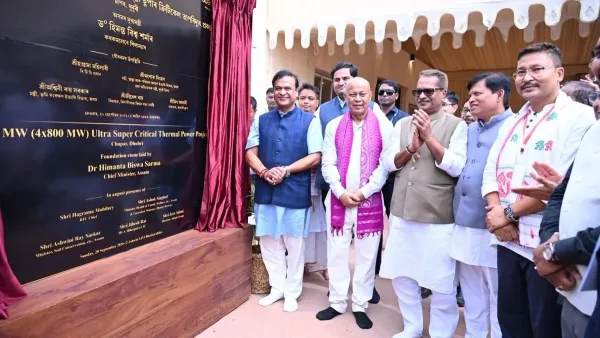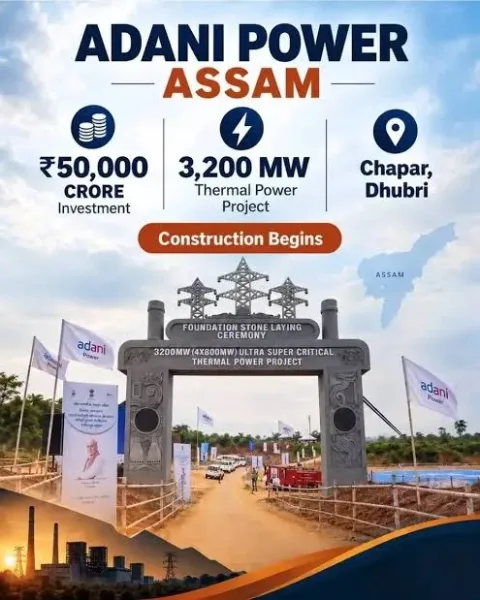
Assam has taken a major step towards expanding its electricity generation capacity with the foundation stone of a 3,200 MW Ultra-Supercritical Thermal Power Plant at Chapar in Dhubri district. Assam Chief Minister Dr. Himanta Biswa Sarma laid the foundation stone of the project on September 20, 2026.
The project is being developed by Adani Power Limited with an estimated investment of around Rs 48,000 crore. It will consist of four generating units of 800 MW each, giving the plant a total installed capacity of 3,200 MW. The project is planned for phased commissioning beginning in December 2030.
For Assam GK and Current Affairs, the Chapar Thermal Power Project is an important development because it connects energy generation, infrastructure, industrial growth, employment and Assam's efforts to increase its own power-generation capacity.
Chapar Thermal Power Plant: Key Facts
- Project name: 3,200 MW Chapar Ultra-Supercritical Thermal Power Plant
- Location: Chapar, Dhubri district, Assam
- Region: Lower Assam
- Developer: Adani Power Limited
- Total capacity: 3,200 MW
- Number of units: 4
- Capacity of each unit: 800 MW
- Technology: Ultra-Supercritical Thermal Power
- Estimated investment: Rs 48,000 crore
- Foundation stone: September 20, 2026
- Planned commissioning: In phases from December 2030
- Construction-phase employment: Up to 20,000 jobs
- Operational employment: Around 5,000 jobs
- Transmission agency: Assam Electricity Grid Corporation Limited (AEGCL)
- Major proposed transmission link: 400 kV Chapar-Rangia transmission system
- Broader Adani Group power investment in Assam: Rs 63,000 crore
Foundation Stone Laid at Chapar in Dhubri
The foundation stone for the 3,200 MW thermal power project was laid at Chapar in Dhubri district on September 20, 2026.
The project represents one of the largest individual investments in Assam's power sector. Adani Power has estimated the investment for the thermal power plant at around Rs 48,000 crore. The company has described the project as a major addition to Assam's electricity infrastructure and an opportunity to support homes, businesses and industries with additional power generation capacity.
The project also follows the investment momentum generated by the Advantage Assam 2.0 investment summit, which was highlighted by the state government and the Adani Group in connection with the project.
Project Capacity: 4 Units of 800 MW Each
The Chapar thermal power plant will have four generating units, each with a capacity of 800 MW.
The calculation is:
800 MW x 4 units = 3,200 MW
This makes the proposed facility a large-scale thermal generation project. Reports have described it as a project that is expected to become the largest power-generation asset in the Northeast once completed.
The large generating capacity is intended to provide Assam with a substantial additional source of electricity and support the state's growing power requirements.
What Is Ultra-Supercritical Thermal Power Technology?
Ultra-Supercritical technology is an advanced form of thermal power generation in which steam is produced at very high temperatures and pressures.
In a conventional coal-based thermal power station, coal is burned to heat water and produce steam. The steam drives a turbine, which is connected to a generator that produces electricity.
Ultra-supercritical plants operate at higher steam conditions than conventional subcritical and ordinary supercritical plants. The higher operating conditions allow the plant to achieve greater thermal efficiency, meaning that more electricity can be generated from a given amount of fuel compared with less efficient thermal technologies.
The technology is therefore intended to improve the efficiency of large coal-based power stations. However, as a coal-based project, the Chapar plant will also be subject to applicable environmental regulations, emissions standards and environmental safeguards.
Investment of Rs 48,000 Crore
The estimated investment in the Chapar thermal power plant is around Rs 48,000 crore.
This makes the project one of the largest individual investments in Assam's power-generation sector. It is also part of a larger Rs 63,000 crore power-sector investment announced by the Adani Group in Assam.
The remaining portion of that broader power investment is associated with two pumped storage projects with a combined capacity of 2,700 MW. These projects are separate from the 3,200 MW Chapar thermal plant but form part of the wider power-sector investment plan.
Expected Commissioning of the Chapar Power Plant
The Chapar thermal power plant is planned to be commissioned in phases starting from December 2030.
Phased commissioning means that the four generating units are expected to become operational progressively rather than all entering commercial operation simultaneously.
Reports have also indicated that full commissioning is targeted over the subsequent phases. Since the project is still under development, the actual commissioning schedule can change depending on construction progress, approvals, equipment supply, transmission readiness and other project requirements.
Employment Opportunities from the Project
The Chapar project is expected to generate substantial employment during both construction and operation.
According to Adani Power, the project could generate up to 20,000 jobs during the construction phase and around 5,000 jobs once the plant becomes operational.
The economic impact is not limited to direct employment. Large infrastructure projects can also create demand for local contractors, transport services, construction suppliers, equipment providers, hospitality businesses and other supporting services.
For Dhubri and surrounding areas, the project therefore has the potential to generate additional economic activity during the construction period and after the plant becomes operational.
Transmission Infrastructure for 3,200 MW Power
Generating 3,200 MW of electricity also requires a strong transmission network capable of carrying the electricity from the power station to the wider grid.
The Assam Electricity Grid Corporation Limited (AEGCL) has initiated work related to transmission infrastructure for evacuating the electricity generated by the upcoming Chapar thermal power plant.
An official AEGCL tender covers the implementation of transmission infrastructure for evacuating 3,200 MW from the Chapar generating station. The proposed works include a 400 kV Chapar-I-Rangia double-circuit transmission line along with associated 400 kV bays and reactor works. The plan also includes a 400/220 kV Agia substation and associated transmission infrastructure connecting Chapar-II and Agia.
AEGCL had also undertaken route alignment, detailed survey and soil investigation work for the proposed 400 kV double-circuit Chapar-Rangia transmission line.
This transmission network is an essential part of the overall project because electricity generated at Chapar must be transferred safely and efficiently to the wider power grid.
Why the Chapar Power Project Is Important for Assam
Assam's electricity demand has been increasing alongside urbanisation, industrial activity, commercial development and population growth.
The Chapar project is intended to add a major source of electricity generation within Assam and reduce the state's dependence on power procured from outside the state.
Additional domestic generation capacity can also support industrial expansion. Industries require reliable electricity for manufacturing, processing, storage and other operations. A stronger power-generation and transmission network can therefore form an important part of Assam's wider infrastructure development.
The project is also expected to contribute to economic activity through employment, local procurement, services and state revenues.
Energy Security and Assam's Power Sector
Energy security means having sufficient and reliable access to energy to meet the requirements of households, businesses and industries.
The Chapar project is being developed within this broader objective. Once operational, its 3,200 MW capacity could substantially increase Assam's installed generation capacity.
The project is particularly significant because it is being developed alongside transmission infrastructure designed specifically to evacuate its output. Generation and transmission therefore need to progress together for the additional capacity to translate into usable electricity for the state and the wider grid.
Chapar Project and the Broader Rs 63,000 Crore Investment
The 3,200 MW Chapar thermal power plant is part of a larger Rs 63,000 crore power investment announced by the Adani Group in Assam.
The broader plan includes:
- Rs 48,000 crore for the 3,200 MW Chapar thermal power project.
- Two pumped storage projects with a combined capacity of 2,700 MW.
- Additional infrastructure and economic activity associated with these projects.
Pumped storage projects are different from thermal power plants. Instead of primarily generating electricity by burning fuel, pumped storage facilities store electricity by moving water between reservoirs at different elevations. They can then release the stored energy when electricity demand is high.
This makes pumped storage useful for balancing electricity supply and demand and supporting grid stability.
How the Chapar Project Was Selected
The project originated through the electricity procurement process conducted by Assam Power Distribution Company Limited (APDCL).
Adani Power received a Letter of Award for the 3,200 MW project, under which the company is responsible for developing the new generating station to supply electricity to Assam.
Adani Power had previously disclosed receiving the Letter of Award for 3,200 MW gross capacity from APDCL under a long-term power procurement arrangement for the new greenfield ultra-supercritical project at Chapar.
The project therefore represents not only a construction initiative but also a long-term addition to Assam's electricity supply infrastructure.
Environmental Considerations
The Chapar project is a coal-based ultra-supercritical thermal power project. While ultra-supercritical technology is designed to operate more efficiently than older thermal technologies, coal-based electricity generation still involves environmental considerations.
Large thermal power projects require compliance with applicable environmental regulations covering issues such as air emissions, water use, ash management and other environmental impacts.
The project therefore has two important dimensions. On one side, it is intended to strengthen electricity availability and support economic development. On the other, its construction and operation must follow the environmental safeguards and regulatory requirements applicable to large thermal power projects.
For current-affairs preparation, this balance between energy security, economic development and environmental protection is an important aspect of understanding the project.
What Is the Role of AEGCL?
Assam Electricity Grid Corporation Limited, commonly known as AEGCL, is responsible for the state's transmission network.
For the Chapar project, AEGCL is developing the infrastructure required to evacuate the electricity generated by the 3,200 MW plant.
The proposed transmission works include the 400 kV Chapar-Rangia transmission system and associated substations and grid infrastructure. The official AEGCL tender specifically identifies the evacuation of 3,200 MW from the upcoming Chapar generating station as the purpose of the works.
This makes AEGCL an important organisation to remember when studying the Chapar Thermal Power Project for Assam GK and Current Affairs.
Chapar Thermal Power Plant and Assam Current Affairs
The project is particularly relevant for students preparing for APSC, ADRE, Assam Police, Assam government recruitment examinations, UPSC and other competitive examinations.
Possible examination questions can focus on the location, capacity, developer, technology, investment, transmission infrastructure and employment potential.
Important facts to remember include:
- The Chapar thermal power plant is located in Dhubri district.
- Chapar is in Lower Assam.
- The project is being developed by Adani Power Limited.
- The total capacity is 3,200 MW.
- The plant will have four units of 800 MW each.
- The estimated investment is Rs 48,000 crore.
- The foundation stone was laid on September 20, 2026.
- Commissioning is planned in phases from December 2030.
- Up to 20,000 jobs are expected during construction.
- Around 5,000 jobs are expected after the plant becomes operational.
- AEGCL is developing transmission infrastructure for power evacuation.
- The proposed transmission system includes a 400 kV Chapar-Rangia line.
- The project forms part of a broader Rs 63,000 crore Adani Group power investment plan in Assam.
Economic Significance for Dhubri
The project is expected to have an economic impact beyond electricity generation.
A large infrastructure project can increase demand for construction workers, engineers, equipment suppliers, transportation services, contractors and other local businesses.
Once the facility becomes operational, a permanent workforce will be required for plant operations, maintenance, security, administration and supporting activities.
The development of supporting infrastructure can also contribute to economic activity in and around Dhubri district.
The project therefore represents a major infrastructure development for western Assam and could influence the region's industrial and service ecosystem over the coming years.
Assam's Move Towards Greater Power Generation Capacity
The Chapar project is part of a broader effort to expand Assam's power infrastructure.
The state requires additional electricity generation capacity to support households, commercial establishments and industries. At the same time, transmission infrastructure must be strengthened so that generated electricity can reach demand centres efficiently.
The combination of the Chapar generating station, dedicated transmission infrastructure and other planned energy projects reflects the growing scale of Assam's power-sector development.
Key Takeaways for Assam GK and Current Affairs
The 3,200 MW Chapar Thermal Power Project is an important 2026 Assam Current Affairs topic.
The most important points are:
- The project is located at Chapar in Dhubri district, Assam.
- Assam Chief Minister Dr. Himanta Biswa Sarma laid its foundation stone on September 20, 2026.
- Adani Power Limited is developing the project.
- The total installed capacity will be 3,200 MW.
- The plant will consist of four 800 MW units.
- The project uses Ultra-Supercritical Thermal Power technology.
- The estimated investment is Rs 48,000 crore.
- Commissioning is planned in phases from December 2030.
- Up to 20,000 jobs are expected during construction.
- Around 5,000 jobs are expected after commissioning.
- AEGCL is developing the transmission infrastructure for evacuating the generated power.
- A proposed 400 kV Chapar-Rangia transmission system is part of the evacuation infrastructure.
- The project is part of a broader Rs 63,000 crore Adani Group power investment plan in Assam.
Conclusion
The 3,200 MW Chapar Ultra-Supercritical Thermal Power Plant is one of the most significant new power-generation projects announced for Assam in 2026. Located in Chapar, Dhubri district, the project involves an estimated investment of Rs 48,000 crore and will consist of four 800 MW generating units.
The project is intended to strengthen Assam's domestic electricity-generation capacity, support energy security and provide a stronger power base for households, businesses and industries. Its expected employment generation and potential to stimulate local supply chains add an important economic dimension.
At the same time, the successful operation of such a large project depends on associated transmission infrastructure. AEGCL's planned 400 kV Chapar-Rangia transmission system and related substations are being developed to evacuate the 3,200 MW generated at the plant.
For Assam GK and Current Affairs, the Chapar Thermal Power Project is important because it brings together several major themes: energy infrastructure, investment, employment, industrial development, electricity generation, transmission and environmental regulation.