Detailed Notes
Introduction: Understanding the UPSC and Its Importance
Every year, lakhs of aspirants from across the country appear for the UPSC Civil Services Examination (CSE) to serve the nation. Before applying, it is crucial to understand the eligibility criteria and requirements that determine who can sit for the UPSC exams.
This article provides a complete and SEO-friendly overview of the eligibility conditions for the UPSC Examination 2025, including nationality, educational qualifications, age limits, attempt restrictions, and physical fitness standards.
1. Nationality – Who Can Apply for UPSC Examinations?
Nationality is the first and most fundamental eligibility criterion for the UPSC examinations.
For IAS, IPS, and IFS posts:
-
The candidate must be a citizen of India.
For other Civil Services posts (like IRS, IAAS, etc.):
Candidates must be either:
-
A citizen of India, or
-
A subject of Nepal or Bhutan, or
-
A Tibetan refugee who came to India before January 1, 1962, intending to settle permanently, or
-
A person of Indian origin who migrated from Pakistan, Burma, Sri Lanka, East African countries, or Vietnam with the intention of permanent settlement in India.
Candidates who are not Indian citizens but fall into the above categories must possess a Government of India-issued eligibility certificate to apply.
Nationality verification is a key part of the document-checking process during the interview stage.
2. Educational Qualification – Minimum Requirement for UPSC Exams
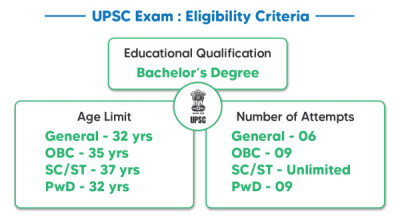
The UPSC requires candidates to possess a Bachelor’s degree from a recognized university or institution. The degree may be in any stream — arts, science, commerce, or professional fields — as long as the university is recognized by the Government of India.
Key points:
-
Minimum qualification: A bachelor’s degree from a recognized university.
-
Final-year students: Those who are in the final year of their graduation or awaiting results are also eligible to appear for the Preliminary Examination. However, they must submit proof of passing the degree before the Main Examination.
-
Medical students: Candidates who have completed their final year of MBBS but have not completed their internship can also apply. They must provide a certificate of course completion from their university along with their Main Exam application.
-
Professional degrees: Candidates with qualifications like CA, ICWA, or other equivalent degrees recognized by the Government are also eligible.
This flexibility ensures that students from a wide variety of academic backgrounds can aspire for administrative and public service careers through UPSC.
3. Age Limit and Relaxations
Age is another critical factor in UPSC eligibility.
For General Category Candidates:
-
Minimum Age: 21 years
-
Maximum Age: 32 years
(As of August 1 of the examination year)
This means a candidate must have been born not earlier than August 2, 1993, and not later than August 1, 2004, for the UPSC 2025 exam.
Category-wise Age Relaxations:
-
OBC candidates: Up to 35 years (3 years relaxation)
-
SC/ST candidates: Up to 37 years (5 years relaxation)
-
Persons with Benchmark Disabilities (PwBD):
-
General/EWS: Up to 42 years
-
OBC: Up to 45 years
-
SC/ST: Up to 47 years
-
These relaxations ensure fair opportunities for all sections of society, in line with the principles of inclusiveness and equality under the Indian Constitution.
4. Number of Attempts for UPSC Examinations
The UPSC limits the number of attempts a candidate can make, depending on their category.
Attempt limits by category:
-
General Category: 6 attempts
-
OBC: 9 attempts
-
SC/ST: Unlimited attempts (up to the age limit)
-
PwBD candidates:
-
General/EWS/OBC: 9 attempts
-
SC/ST: Unlimited attempts
-
Even if a candidate appears for only one paper of the Preliminary Examination, it is counted as one attempt.
Candidates who have exhausted all attempts or crossed the maximum age limit are not eligible to reapply.
5. Physical Fitness Requirements
Physical and medical fitness is essential, particularly for posts like Indian Police Service (IPS), Indian Railway Protection Force (RPF), and Indian Defence Accounts Service (IDAS).
Basic Requirements:
-
Candidates must be in sound physical and mental health.
-
Medical examinations are conducted after the final interview.
-
Specific physical standards apply for IPS and certain other services.
Examples of IPS physical standards:
-
Minimum Height:
-
Men: 165 cm (160 cm for SC/ST and certain regions)
-
Women: 150 cm (145 cm for SC/ST and certain regions)
-
-
Chest Girth:
-
Men: Minimum 84 cm (expansion of 5 cm)
-
Women: Minimum 79 cm (expansion of 5 cm)
-
-
Vision Standards:
-
Distant vision: 6/6 or 6/9 (better eye) and 6/12 or 6/9 (worse eye)
-
Corrected vision allowed (using glasses/contact lenses).
-
Physical standards ensure that officers can perform demanding field duties effectively.
6. Other Restrictions and Disqualifications
To maintain fairness and transparency, the UPSC has outlined strict rules regarding eligibility restrictions.
-
Debarred candidates: Individuals banned from any UPSC or government examination due to misconduct or fraud are not eligible.
-
Fraudulent information: Providing false information or fake certificates leads to permanent disqualification and legal action.
-
Exhausted attempts: Candidates who have used all their attempts or exceeded the upper age limit cannot reapply.
-
Government employees: Those already in service must provide a No Objection Certificate (NOC) from their department while applying.
7. Importance of Fulfilling UPSC Eligibility Criteria
Understanding and meeting UPSC eligibility requirements is the first step to success. Many applications are rejected due to simple errors such as:
-
Wrong date of birth
-
Incomplete documentation
-
Missing proof of degree completion
-
Exceeding attempt limits
Aspirants are advised to carefully read the UPSC notification published every year on the official website before applying.
It’s also essential to keep digital copies of all required documents — including ID proofs, mark sheets, certificates, and photos — ready for upload during the online application process.
8. Quick Summary Table – UPSC Eligibility 2025
| Criteria | Requirement |
|---|---|
| Nationality | Indian citizen or eligible categories (Nepal, Bhutan, Tibetan refugee, PIO) |
| Educational Qualification | Bachelor’s degree from a recognized university |
| Final-Year Eligibility | Allowed for prelims (degree proof before mains) |
| Age Limit (General) | 21–32 years (as of August 1, 2025) |
| Age Relaxation | OBC – 3 years, SC/ST – 5 years, PwBD – up to 10 years |
| Number of Attempts | General – 6, OBC – 9, SC/ST – Unlimited |
| Physical Standards | Required for IPS and certain posts |
| Medical Fitness | Mandatory for all candidates |
| Restrictions | Debarred candidates or those who exhausted attempts cannot apply |
Conclusion
The Union Public Service Commission (UPSC) sets clear and transparent eligibility criteria to ensure that only the most qualified, capable, and deserving candidates join India’s top civil services.
From nationality and educational qualifications to age limits, attempt counts, and physical fitness, each requirement ensures that candidates are well-prepared for the responsibilities of national service.
Before applying, aspirants must read the official UPSC notification carefully, verify all eligibility parameters, and maintain valid documents. Meeting these conditions not only prevents disqualification but also ensures a smooth and confident journey toward becoming an IAS, IPS, IFS, or other Central Service officer — serving the nation with pride and integrity.
Frequently Asked Questions (FAQs) on UPSC Eligibility and Requirements
1. What is the minimum qualification required for the UPSC Civil Services Examination?
To appear for the UPSC Civil Services Examination, a candidate must hold a bachelor’s degree from a recognized university or institution approved by the Government of India.
Students in their final year of graduation can also apply for the Preliminary Examination, provided they submit proof of passing the degree before the Main Examination.
2. What is the age limit for the UPSC 2025 Examination?
For the UPSC 2025 exam, the minimum age is 21 years, and the maximum age is 32 years as of August 1, 2025.
This means the candidate must have been born not earlier than August 2, 1993, and not later than August 1, 2004.
However, there are relaxations for reserved categories:
-
OBC: Up to 35 years
-
SC/ST: Up to 37 years
-
PwBD: Up to 42 years (for General/EWS), 45 years (for OBC), and 47 years (for SC/ST)
3. How many attempts are allowed for the UPSC examination?
The number of attempts is limited based on the candidate’s category:
-
General: 6 attempts
-
OBC: 9 attempts
-
SC/ST: Unlimited attempts (up to the age limit)
-
PwBD: 9 attempts for General/OBC/EWS, unlimited for SC/ST
Even if a candidate appears in only one paper of the Preliminary Examination, it is counted as an attempt.
4. Can final-year students apply for the UPSC exam?
Yes, final-year graduation students or those awaiting results are eligible to appear for the UPSC Preliminary Examination. However, they must produce proof of passing the degree before applying for the Main Examination. This provision allows students to begin early preparation without waiting for degree results.
5. What are the physical fitness requirements for the UPSC examination?
All candidates must be in good physical and mental health.
However, specific services such as the Indian Police Service (IPS), Indian Railway Protection Force (RPF), and Indian Defence Accounts Service (IDAS) have additional physical standards related to height, weight, and chest measurements.
For example, for the IPS:
-
Height: Men – 165 cm; Women – 150 cm (relaxations for SC/ST)
-
Chest: Men – 84 cm (expandable 5 cm); Women – 79 cm (expandable 5 cm)
-
Vision: Distant vision should be 6/6 or 6/9 (with correction allowed).
6. Who is not eligible to apply for the UPSC exams?
You are not eligible for the UPSC exams if:
-
You have exhausted all permitted attempts.
-
You have crossed the upper age limit for your category.
-
You have been debarred or banned by the UPSC or any government body for unfair practices.
-
You provide false or misleading information in your application form.
-
You fail to meet nationality or educational qualification requirements.
7. Can a candidate with a professional degree apply for UPSC?
Yes, candidates with professional degrees such as B.Tech, MBBS, CA, ICWA, or similar qualifications from recognized institutions are eligible. Medical students who have completed their final year of MBBS but not their internship can also apply, provided they submit a course completion certificate with their Main Exam application.
8. What is the required nationality for UPSC applicants?
For IAS, IPS, and IFS posts, the candidate must be an Indian citizen.
For other services, candidates may also be:
-
Citizens of Nepal or Bhutan,
-
Tibetan refugees who came to India before January 1, 1962, intending to settle permanently, or
-
Persons of Indian Origin (PIO) who migrated from specific countries like Pakistan, Sri Lanka, or Burma.
Non-Indian citizens must obtain a Government of India eligibility certificate before appointment.
9. Is there a limit on how many times a candidate can apply for UPSC?
Yes, UPSC imposes a limit on attempts, which depends on the category.
General candidates can attempt 6 times, OBC candidates 9 times, and SC/ST candidates have no limit (until they reach the maximum age).
Candidates must also remember that appearing in one paper of the preliminary exam counts as an attempt.
10. What documents are required while applying for UPSC exams?
Candidates must upload scanned copies of the following documents during the online application process:
-
Passport-size photograph and signature
-
Proof of date of birth (Class 10 certificate)
-
Degree certificate or mark sheet
-
Caste certificate (if applicable)
-
Disability certificate (for PwBD)
-
Government-issued ID proof (Aadhaar, PAN, etc.)
-
For government employees, a No Objection Certificate (NOC)
Submitting false or inconsistent documents may lead to disqualification and permanent debarment from future UPSC exams.
11. What happens if a candidate provides false information in the UPSC application?
Providing false, fabricated, or misleading information in the UPSC form results in immediate disqualification, cancellation of candidature, and possibly a permanent ban from all future examinations conducted by the Commission.
Additionally, legal action can be initiated under relevant provisions of the law.
12. Where can I check official UPSC eligibility notifications?
All official notifications, eligibility details, and updates about upcoming exams are available only on the UPSC official website. Aspirants should regularly visit this site to verify the latest eligibility norms, important dates, and syllabus to ensure accuracy before applying.
Conclusion (for FAQ Section)