Detailed Notes
Territorial Reorganization and Administrative Changes
At the time of independence, Assam included vast regions that today form separate states. Over the years, different ethnic groups demanded autonomy to preserve their unique cultural and social identities. This led to major territorial restructuring:
-
Nagaland became a separate state in 1963, marking the first major territorial division of Assam.
-
Meghalaya gained autonomy in 1970 and full statehood in 1972, after which the state capital shifted permanently from Shillong to Dispur.
-
Mizoram and Arunachal Pradesh became Union Territories in 1972 and later full-fledged states in 1987 and 1986.
-
Assam also lost Sylhet to East Pakistan (now Bangladesh) during the partition through a referendum.
-
In 1951, Dewangiri in North Kamrupa was ceded to Bhutan.
These changes significantly reduced Assam's geographical area but helped in addressing long-standing demands for self-governance among tribal and hill communities.
Linguistic and Identity-Based Movements
Language and identity have played a central role in Assam's political history. The Assam Official Language Act of 1960 declaring Assamese as the official language triggered strong resistance in the Barak Valley, where Bengali-speaking communities opposed the decision. This led to the historic 1961 Language Movement, after which Bengali was recognized as an official language in the Barak Valley. These developments highlighted Assam's diverse linguistic and cultural landscape.
The Assam Movement (1979–1985)
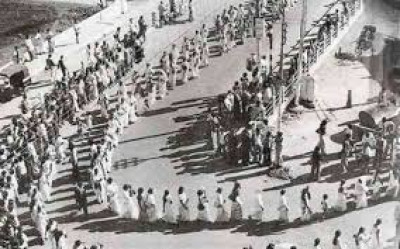
One of the most defining events in post-independence Assam was the Assam Movement, a massive uprising against illegal immigration from East Pakistan (later Bangladesh). Led by AASU and AAGSP, the movement demanded identification and deportation of foreigners who had entered Assam after 24 March 1971. The agitation continued for six years and witnessed both peaceful demonstrations and violent incidents, including the tragic Nellie massacre in 1983.
The movement concluded with the signing of the Assam Accord on 15 August 1985, a landmark agreement that:
-
Set March 24, 1971 as the cut-off date for detecting illegal immigrants.
-
Promised constitutional and legislative safeguards for the indigenous population.
-
Initiated steps for updating the National Register of Citizens (NRC).
Following the Accord, movement leaders formed the Asom Gana Parishad (AGP) and came to power the same year, marking a major shift in Assam's political landscape.
Insurgency and Peace Processes
The post-accord era saw the rise of militant groups such as ULFA and various Bodo armed organizations demanding sovereignty or greater autonomy. Insurgency affected Assam's stability and development for decades. Over time, several groups surrendered arms and engaged in peace talks. The most significant progress came with the 2020 Bodo Peace Accord, leading to the formation of the Bodoland Territorial Region (BTR) with enhanced administrative powers.
Economic Growth and Infrastructure Development
Assam's natural resources, including oil, natural gas, limestone, and tea, have always played a key role in its economy. Post-independence developments include:
-
Establishment of Gauhati University (1948) and Gauhati High Court (1948).
-
Growth of the oil and gas sector, with refineries such as Noonmati Refinery (1962) and later Numaligarh Refinery.
-
Construction of major infrastructure like the Saraighat Bridge (1962–65) over the Brahmaputra.
-
Expansion of the tea industry, industrial units, and agricultural modernization efforts.
-
Better connectivity through national highways, airports, and rural road networks.
Despite recurring floods and political instability, Assam has steadily moved toward economic progress.
Cultural and Social Developments
Assam continued to celebrate its composite heritage of tribes, ethnic groups, and linguistic communities. Over the decades, revival of traditional art, literature, festivals, and classical dance forms strengthened the state's cultural identity. Assamese cinema, literature, and music flourished, making Assam a vibrant center of art and storytelling in Northeast India.