Life & Legacy
Early Life and Family
Parbati Barua was born on 14 March 1953 in Gauripur, located in present-day Dhubri district of Assam. She belongs to the historic royal family of Gauripur. Her father, Prakritish Chandra Barua, was the last Raja of Gauripur and was widely respected for his extraordinary knowledge of elephants and forest life. The royal estate maintained a large number of elephants, and from an early age Parbati spent much of her childhood accompanying her father on forest expeditions. These experiences developed her deep understanding of elephant behaviour, wildlife, and the natural environment.
Education
Parbati Barua studied at Gauhati University, where she pursued Political Science. Although she received formal education, her true passion always remained wildlife conservation and elephant management. She chose an unconventional path by dedicating her life to elephants instead of following a traditional profession.
Beginning of Her Journey as a Mahout
At the age of 14, Parbati Barua successfully participated in capturing and taming her first wild elephant in the Kochugaon forests of Assam. This achievement marked the beginning of an extraordinary career in a profession that had traditionally been dominated by men.
Following the abolition of the privy purse, her family experienced significant financial challenges. Rather than leaving behind the forests, she continued working alongside her father, training elephants and assisting forest authorities. Her dedication, courage, and natural ability earned her recognition as India's first female elephant mahout, breaking long-standing social barriers and proving that expertise has no gender.
Wildlife Conservation and Elephant Management
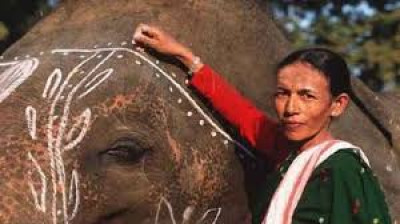
For more than five decades, Parbati Barua has worked extensively in elephant conservation and welfare. She has trained and handled over 500 elephants, making her one of India's most experienced elephant experts.
Her practical knowledge has supported forest departments in Assam, West Bengal, Odisha, Kerala, Uttar Pradesh, Uttarakhand, and Bihar, particularly in safely managing wild elephants that enter villages, tea gardens, and agricultural fields. Instead of relying solely on modern methods, she combines traditional elephant-handling techniques with patience, trust, and compassion.
She has played a major role in reducing human-elephant conflict, helping protect both wildlife and local communities while promoting peaceful coexistence between humans and elephants.
International Recognition
Parbati Barua's expertise has earned worldwide appreciation. She has represented India at several international wildlife programmes, including the International Workshop on Domesticated Asian Elephants held in Bangkok. She has also served as a member of the Asian Elephant Specialist Group under the International Union for Conservation of Nature (IUCN), contributing valuable traditional knowledge to global elephant conservation efforts.
Her inspiring life became internationally known after British conservationist Mark Shand wrote the book Queen of the Elephants, which was later accompanied by a BBC documentary showcasing her exceptional bond with elephants.
Major Achievements
- India's first female elephant mahout.
- Trained and managed more than 500 elephants.
- Worked for over five decades in wildlife conservation.
- Assisted forest departments across multiple Indian states.
- Helped reduce human-elephant conflicts through practical conservation methods.
- Promoted traditional knowledge of elephant behaviour and welfare.
- Inspired women to enter wildlife conservation and forest services.
- Represented India in international elephant conservation programmes.
Positions Held
- Member, Asian Elephant Specialist Group (IUCN).
- Honorary Chief Elephant Warden of Assam (Government of Assam).
Awards and Recognition
- Padma Shri (2024) for contribution to wildlife conservation.
- Asom Gaurav Award (2023) by the Government of Assam.
- Global 500 Roll of Honour (1989) by the United Nations Environment Programme (UNEP).
- Honorary Chief Elephant Warden of Assam (2003).
- Nature's Warrior Jury Award for the documentary Aparajita at the Kolkata International Wildlife and Environment Film Festival.
Books About Parbati Barua
- Queen of the Elephants by Mark Shand.
Legacy
Parbati Barua's legacy extends far beyond her achievements as a mahout. She transformed public perception by becoming the first Indian woman to excel in a profession once considered exclusively for men. Her lifelong commitment to elephants has strengthened wildlife conservation efforts across India while preserving valuable traditional knowledge about elephant behaviour. Through her courage, compassion, and environmental leadership, she has become one of Assam's greatest conservation icons and an enduring inspiration for future generations dedicated to protecting wildlife and maintaining harmony between humans and nature.
FAQs Parbati Barua
1. Who is Parbati Barua?
Parbati Barua is India's first female elephant mahout, a renowned wildlife conservationist from Assam, and a Padma Shri awardee known for her lifelong work with elephants.
2. Why is Parbati Barua famous?
She is famous for becoming India's first woman mahout, training over 500 elephants, and making significant contributions to wildlife conservation and elephant welfare.
3. When and where was Parbati Barua born?
Parbati Barua was born on 14 March 1953 in Gauripur, Dhubri district, Assam.
4. Who was Parbati Barua's father?
Her father was Prakritish Chandra Barua, the last Raja of Gauripur and a respected elephant expert.
5. Which award did Parbati Barua receive in 2024?
She received the Padma Shri, one of India's highest civilian honours, in 2024 for her contribution to wildlife conservation.
6. Why is Parbati Barua called Hasti Kanya?
She is called Hasti Kanya, meaning Elephant Girl, because of her extraordinary lifelong relationship with elephants and her pioneering role as a female mahout.
7. What is Parbati Barua's contribution to elephant conservation?
She has trained more than 500 elephants, helped reduce human-elephant conflicts, assisted forest departments across India, and promoted ethical elephant management.
8. Which book is based on the life of Parbati Barua?
The book Queen of the Elephants, written by Mark Shand, is based on her remarkable life and work.
9. Is Parbati Barua associated with any international conservation organisation?
Yes. She has been associated with the Asian Elephant Specialist Group of the International Union for Conservation of Nature (IUCN).
10. Is Parbati Barua still alive?
Yes. Parbati Barua is alive and continues to support wildlife conservation while inspiring future generations through her lifelong dedication to elephants.