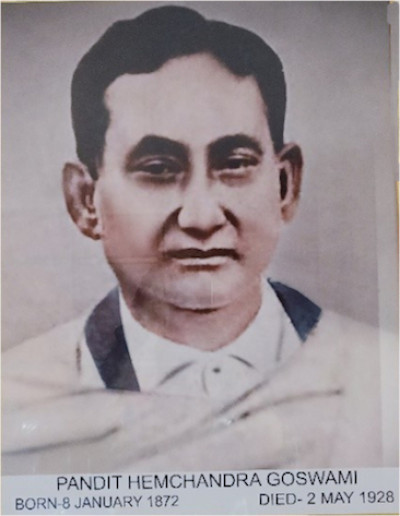
Life & Legacy
Early Life and Family Background
Hemchandra Goswami was born on 8 January 1872 at Gauranga Satra, located in Dhekiyal mouza of present-day Golaghat district, Assam. He was born into a respected Vaishnavite family deeply associated with satra culture. His father, Dambaru Dhar Goswami, served as the Satradhikar of Gauranga Satra and also held the position of mouzadar. His mother, Ghanakanti Devi, played an important role in nurturing his early education and moral values.
Growing up in a religious and intellectually active environment exposed Hemchandra Goswami to classical Assamese literature, spiritual discourse, and manuscript traditions from an early age. This early exposure later influenced his lifelong dedication to preserving and enriching Assamese language and literature.
Education and Intellectual Formation
Hemchandra Goswami began his education at the village school, where his academic brilliance earned him a modest scholarship. He later joined Williamson Minor School in Golaghat, followed by Nagaon Government High School, from where he passed the Entrance Examination in 1888 with distinction. His academic excellence was recognized through financial stipends, which helped him pursue higher studies.
He then moved to Calcutta, the intellectual hub of British India, and enrolled at Presidency College. During his years in Calcutta, Goswami came into contact with new literary movements, Western poetic forms, and modern critical thinking. Although he did not complete his Bachelor degree and returned to Assam, the intellectual exposure he gained in Calcutta proved crucial in shaping his literary vision.
Role in the Jonaki Era and Literary Awakening
Hemchandra Goswami was one of the central figures of the Jonaki era, considered the golden phase of modern Assamese literature. While studying in Calcutta, he, along with Chandrakumar Agarwala and Lakshminath Bezbarua, established the Asomiya Bhasha Unnati Sadhini Sabha in 1888. This organization aimed to revive Assamese language, literature, and cultural pride at a time when Assamese identity was under threat.
The Sabha launched its literary journal Jonaki in 1889, which became the platform for introducing romanticism, modern poetry, and new literary forms in Assamese literature. Hemchandra Goswami served as editor of Jonaki during its second year and played a major role in shaping its editorial direction. Through Jonaki, he encouraged creative experimentation and literary excellence, marking a decisive break from earlier traditional styles.
Contribution as a Poet and Sonnet Writer
Hemchandra Goswami is best remembered as the first Assamese poet to introduce the sonnet form. Inspired by European poetic traditions, particularly the Italian poet Petrarch, he adapted the sonnet structure to Assamese language with remarkable success. His famous sonnet Priyotomar Chithi stands as a landmark in Assamese poetry, combining emotional depth with structural discipline.
His poetry collection Phular Saki, published in 1907, contains several notable poems that reflect romantic themes, human emotions, and aesthetic sensibility. Poems like Puwa, Kako aru Hiya Nibilau, and Kakuti reveal his mastery over language and imagery. The poem Puwa is often regarded as the beginning of modern Assamese poetry, as it introduced new poetic expression rooted in personal emotion rather than classical imitation.
Hemchandra Goswami is widely acknowledged as one of the foremost romantic poets of Assam, whose works bridged tradition and modernity.
Career in Administration and Public Service
In 1894, Hemchandra Goswami began his professional career as the Headmaster of Sonaram High School in Guwahati. However, differences with school authorities led him to resign. In 1895, with the support of historian Edward Gait, he joined government service at the Shillong Secretariat.
From 1897 onwards, he served in various administrative roles including Sub-Deputy Collector, Extra Assistant Commissioner, and Deputy Magistrate. Despite the demands of his official duties, Goswami continued his literary and scholarly pursuits. He retired from government service in 1925, leaving behind a legacy that balanced administrative responsibility with cultural dedication.
Manuscript Collection and Scholarly Work
One of Hemchandra Goswamis most valuable contributions lies in his work as a collector, editor, and cataloger of Assamese manuscripts. During his government assignments, he traveled extensively across Assam and collected ancient manuscripts from villages, towns, and satras. In a short span of time, he gathered over a thousand manuscripts, many of which might have been lost without his intervention.
He meticulously studied more than a thousand manuscripts and prepared a detailed catalog, which was later published by the Assam Government as A Descriptive Catalogue of Assamese Manuscripts. This work remains a foundational reference for researchers and scholars of Assamese literature.
At the request of Calcutta University, he began compiling Asomiya Sahityar Chaneki, an anthology of Assamese literature, further contributing to academic recognition of Assamese literary heritage.
Editorial Contributions
Hemchandra Goswami also edited several important texts that preserved the intellectual history of Assam. His editorial work on Hemkosh, the authoritative Assamese dictionary compiled by Hemchandra Barua, significantly enhanced its scholarly value. He also edited classical works such as Katha Gita, Hastividyarnava, Purani Asomiya Buranji, and other historical and philosophical texts.
Through his editorial efforts, he ensured that future generations had access to authentic and well-organized literary resources.
Role in Assam Sahitya Sabha
Hemchandra Goswami was deeply involved in the formation and growth of the Assam Sahitya Sabha, the premier literary organization of Assam. From its earliest conceptual stages, he worked closely with fellow literary leaders to organize a statewide literary movement. In 1920, he presided over the Tezpur session of the Assam Sahitya Sabha as its President, further solidifying his role as a guiding force in Assamese literary development.
Death and Legacy
Hemchandra Goswami passed away on 2 May 1928 at his residence in Guwahati. Though his life was relatively short, his contributions left an enduring impact on Assamese literature, scholarship, and cultural consciousness.
Today, Hemchandra Goswami is remembered as a pioneer who modernized Assamese poetry, safeguarded its manuscript heritage, and helped build institutions that continue to shape Assamese identity.
FAQs on Hemchandra Goswami
FAQ 1: Who was Hemchandra Goswami?
Hemchandra Goswami was a pioneering Assamese poet, scholar, and administrator known as the first sonnet writer in Assamese literature.
FAQ 2: Why is Hemchandra Goswami famous?
He introduced the sonnet form to Assamese poetry and played a major role in modernizing Assamese literature.
FAQ 3: What is Hemchandra Goswami best known for?
He is best known for his sonnet Priyotomar Chithi and his role in the Jonaki literary movement.
FAQ 4: When was Hemchandra Goswami born?
He was born on 8 January 1872 in Golaghat district of Assam.
FAQ 5: What was his contribution to Assamese poetry?
He introduced romanticism, modern poetic forms, and emotional expression into Assamese poetry.
FAQ 6: Was Hemchandra Goswami part of Assam Sahitya Sabha?
Yes, he was closely associated with its formation and served as its President in 1920.
FAQ 7: Did Hemchandra Goswami work in government service?
Yes, he served as Deputy Magistrate and Extra Assistant Commissioner before retiring in 1925.
FAQ 8: What manuscripts did Hemchandra Goswami collect?
He collected and cataloged over a thousand ancient Assamese manuscripts from across the state.
FAQ 9: What books did Hemchandra Goswami edit?
He edited Hemkosh dictionary, Katha Gita, Purani Asomiya Buranji, and several other classical works.
FAQ 10: When did Hemchandra Goswami die?
He passed away on 2 May 1928 in Guwahati.