Indigenous Flood Prediction Techniques of Assam: How Villagers Read Nature to Survive Brahmaputra Floods
Introduction: Living with the Brahmaputra
In Assam, floods are not unexpected disasters but recurring seasonal realities. Every year, the mighty Brahmaputra overflows during the monsoon, affecting thousands of lives. Long before modern forecasting systems, rural communities across Majuli, Dhemaji, Golaghat and other riverine regions developed indigenous flood prediction techniques rooted in close observation of nature.
These traditional systems, passed down orally through generations, combine environmental awareness, animal behavior study, agricultural wisdom and cultural practices. Even today, many villagers rely on these early warning signs to prepare for rising waters.
Reading Nature: Early Warning Signs from Flora and Fauna
1. Animal Behavior as Flood Indicators
Assamese villagers strongly believe animals sense environmental changes before humans.
-
Restless cows running uncontrollably indicate heavy rain and floods.
-
If dark colored cows behave nervously, flooding may be severe.
-
If cows lie calmly on the ground, it is considered a positive sign of a flood free year.
-
Ants carrying eggs in long lines suggest rising water levels.
-
Continuous loud croaking of frogs, especially the yellow bellied byagar byang, signals heavy rainfall.
-
Sudden appearance or strange nesting patterns of vultures may indicate storms or cyclones.
-
Wild animals moving towards higher ground warn of approaching floods.
However, villagers acknowledge that climate change has made some of these signs less predictable than before.
Agricultural and Seasonal Indicators
The Proverb: Ame baan, kothale dhaan
A well known Assamese saying goes: Ame baan, kothale dhaan.
This means:
-
Abundant mango blossoms predict severe floods.
-
A good jackfruit season suggests a better rice harvest and fewer floods.
This proverb reflects generations of environmental observation and seasonal correlation.
Fish Movement Patterns
Villagers observe fish behavior carefully:
-
If fish such as Baikhi jump frequently during April and May, it signals rising river levels.
-
If water bodies show fewer fish early in the rainy season, floods may follow.
Bamboo Flowering
Mass flowering of bamboo before summer is considered a warning sign of high intensity flooding.
River and Sky Observations
Communities closely monitor the Brahmaputra and its tributaries.
-
Soil sediments flowing downstream before monsoon indicate heavy upstream rainfall and possible floods.
-
If tributaries from Arunachal Pradesh swell due to hill rainfall, plains may flood within 24 to 36 hours.
-
A loud chhap chhap sound of water in agricultural fields signals rising water levels.
-
Continuous rainfall for more than a week at the beginning of the rainy season predicts major flooding.
-
The moon tilting southwards is traditionally believed to indicate heavy rainfall.
-
If the Brahmaputra rises on Ambubachi day in June, floods are expected to persist throughout the season.
These environmental readings form a natural early warning system.
Kaso Pithiya: Elevated Earth Structures
To manage waterlogging, villagers construct semi circular raised earthen mounds known as kaso pithiya. These turtle shaped elevations help protect essential items and provide temporary dry space during floods.
The Mishing Community: Masters of Flood Adaptation
The Mishing community of Majuli Island demonstrates one of the most remarkable examples of indigenous disaster risk reduction.
Chang Ghar: Stilt Houses
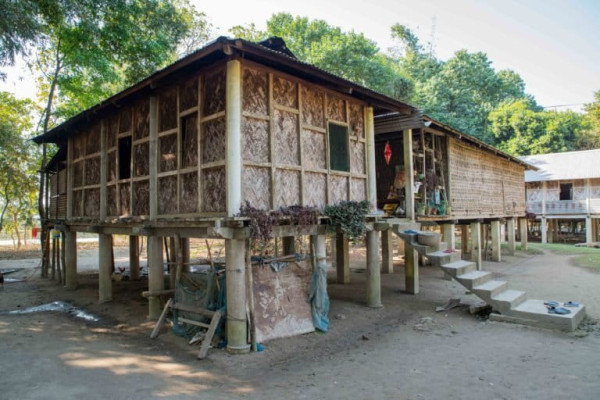
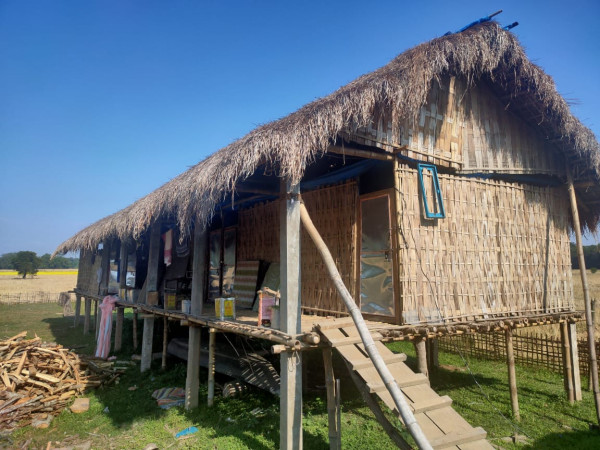
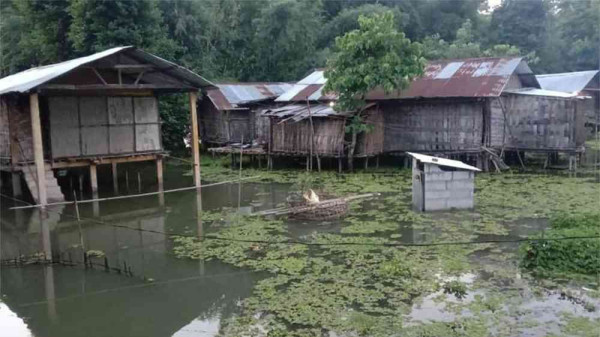
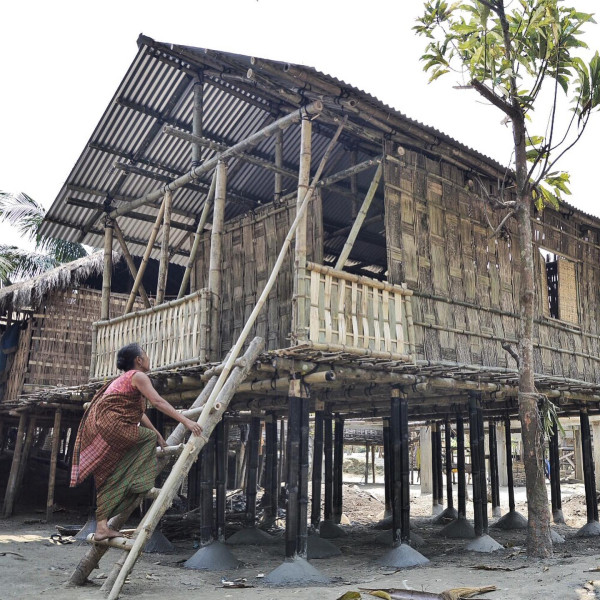
Mishing homes, known as Chang Ghar, are built on bamboo or wooden stilts about 6 to 10 feet above ground.
Key features:
-
Long rectangular design
-
Open hall structure without small partitions
-
Two doors, front and rear
-
Raised platforms for livestock and storage
-
Traditional thatched roofs, sometimes replaced with tin sheets
-
Brick pillars used in some modern adaptations
Unless floodwaters exceed seven feet, these houses remain safe. Even during floods, daily life continues with minimal disruption.
Boats and Mobility
Every household keeps:
-
Large boats or dugout canoes
-
Temporary banana trunk rafts called Ollung
During floods, villagers travel by rowing instead of walking. Every member of the community knows swimming and rowing.
Halla Alert System
In case of sudden flooding, villagers use the Halla system. News of breaches or rising water is shouted and passed from house to house, creating a rapid community alert mechanism.
Indigenous Agricultural Adaptation
Flood resilience is deeply embedded in farming practices.
-
Deep water rice is grown in low lying areas. It survives submergence and can be harvested after floods.
-
Saali paddy is cultivated in higher lands.
-
Floodwaters deposit fertile silt, improving soil quality.
-
However, sand deposition and erosion remain major challenges.
Historically, the Mishings practiced shifting cultivation and relocated when soil fertility declined. Over time, they adapted to settled agriculture in floodplains.
Community Preparedness and Modern Integration
In recent decades, indigenous systems have been complemented with modern disaster preparedness:
-
Elevated granaries built with strong foundations
-
Steel sheet covered pillars to protect stored food from rodents
-
Ham radio communication systems
-
Local radio updates during monsoon
-
Hygiene awareness posters and sanitation kits
-
Improved housing materials while preserving traditional architecture
Experts estimate that traditional forecasting methods are 75 to 80 percent accurate. Integration of indigenous knowledge with scientific early warning systems strengthens resilience against climate change.
Why Indigenous Knowledge Matters Today
Modern development often overlooks local wisdom. Yet communities living along the Brahmaputra have survived for centuries because their disaster mitigation techniques evolved in harmony with the ecosystem.
Indigenous knowledge:
-
Respects biodiversity
-
Supports eco friendly living
-
Enhances disaster risk reduction
-
Preserves cultural identity
-
Strengthens climate change adaptation strategies
Blending scientific forecasting with traditional wisdom offers a sustainable approach to managing floods in Assam.
Conclusion
The indigenous flood prediction techniques of Assam are not mere folklore. They represent centuries of ecological intelligence, observation and adaptation. From reading animal behavior to constructing Chang Ghars and cultivating flood resistant crops, these communities have mastered coexistence with nature.
In a time of increasing climate uncertainty, preserving and integrating this knowledge is essential for building a resilient future along the Brahmaputra.