Chutia Kingdom History: The Powerful Pre-Ahom Empire of Eastern Assam
Introduction: Before the Rise of the Ahoms
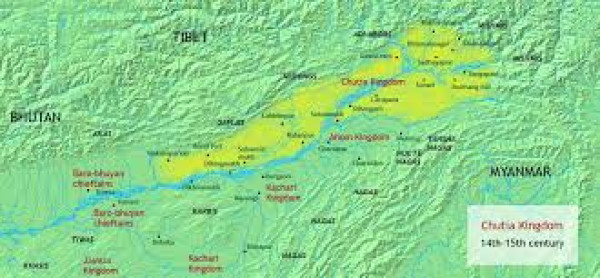
Before the Ahom dynasty established its long rule in Assam, the eastern Brahmaputra Valley was dominated by a powerful and organized state known as the Chutia Kingdom. Founded around 1187 CE, this medieval kingdom controlled vast territories across present-day Assam and Arunachal Pradesh. With its advanced administration, strong military structure, rural industries, and fortified capitals, the Chutia state was one of the most significant political powers in northeast India between the 12th and early 16th centuries.
Foundation and Early Growth
The Chutia Kingdom is traditionally believed to have been founded in 1187 CE by Birpal, a Chutia chieftain who claimed descent from the legendary Bhishmak. Birpal ruled over numerous clans from his capital at Swarnagiri and assumed the title Gayapal. Over time, his successors united various Chutia chieftains across hill and plain regions to form a consolidated kingdom.
One of the most powerful early rulers was Gaurinarayan, also known as Ratnadhwajpal. He expanded the kingdom significantly by subjugating neighboring hill tribes and defeating rival chiefs. In 1224, he defeated Bhadrasena of Swetagiri and annexed territories between the Subansiri and Sissi rivers. He later campaigned toward Biswanath and formed alliances through strategic marriages with regional rulers, including the Kamata kingdom.
Gaurinarayan built forts along strategic routes, constructed temples and large tanks, and established Ratnapur in Majuli as a major capital. The later capital at Sadiya derived its name from a tragic event involving his son, and it became the political heart of the kingdom.
Political Structure and Polity
The origins of the Chutia polity are not fully documented, but the kingdom clearly emerged as a structured state around Sadiya by the 14th century. Epigraphic evidence identifies early rulers such as Nandin or Nandisvara and his successor Satyanarayana, also identified as Ratnanarayana.
Some inscriptions suggest matrilineal influences within the ruling family, as royal lineage was traced through maternal connections linked to Asura ancestry. Later rulers like Durlabhnarayana and Dharmanarayana further strengthened political administration.
The kingdom is also referred to as Sadiya in Ahom chronicles, with Ahom Buranjis calling it Tiora, while Assamese chronicles refer to it as Chutia.
Territorial Extent and Geography
At its height, the Chutia Kingdom controlled territories from Parshuram Kund in present Arunachal Pradesh in the east to Vishwanath in present Assam in the west. It covered modern districts such as Lakhimpur, Dhemaji, Tinsukia, parts of Dibrugarh, Sonitpur, and extended into areas of East Siang, Subansiri, Lohit, and Lower Dibang Valley.
The kingdom primarily governed fertile river valleys of the Brahmaputra, Subansiri, Lohit, and Dihing rivers. While its influence extended toward hill regions, its core power base remained in the plains and foothills.
Economy and Rural Industries
The Chutia state was considered one of the most advanced among emerging medieval states in Assam after the fall of Kamarupa. It possessed a surplus agrarian economy supported by settled cultivation, though exact agricultural systems remain debated.
The kingdom was known for gold washing, weaving, and artisan production. Prisoners of war and skilled communities such as Brahmins, Tantis, Sonaris, Sutars, and Kumars were resettled in different parts of the kingdom, strengthening economic production.
Trade networks linked the region internally and externally, and the kingdom had a stable surplus economy compared to neighboring polities.
Religion and Cultural Developments
Initially rooted in indigenous traditions, the Chutia rulers gradually came under Brahmanical influence during the late 14th century. Vaishnavism gained prominence, and Brahmins constructed genealogies linking rulers to Krishna legends, though placing them lower in Brahminical hierarchy due to their indigenous origins.
Despite Sanskritisation, the rulers continued to patronize the powerful tribal deity Dikkaravasini, also known as Tamresvari or Kechai-khati. This deity was worshipped under a Deori priesthood system and remained outside orthodox Brahminical control even during later Ahom rule.
This dual religious framework reflected the syncretic culture of the kingdom.
Military Strength and Early Conflicts
The Chutia Kingdom maintained fortified towns and defensive structures. Early contact with the Ahoms occurred during the reign of the Ahom king Sutuphaa in the 14th century. Friendly negotiations turned hostile when Sutuphaa was killed during a diplomatic encounter, triggering prolonged conflict.
Major conflicts occurred between 1512 and 1523 under the Ahom king Suhungmung. After annexing Panbari of Habung, Suhungmung clashed with Chutia ruler Dhirnarayan. Fortifications such as Posola-garh and Mungkhrang became key battlegrounds.
In 1520, Chutia forces briefly captured an Ahom fort and killed its commander, but subsequent Ahom counterattacks regained control. In 1523-24, the Ahoms decisively defeated the Chutia king, who was killed along with his son according to major chronicles. The fall of Sadiya marked the end of Chutia sovereignty.
Downfall and Ahom Annexation
The final phase of decline occurred under Nityapal, whose weak leadership and internal noble resistance weakened the state. In 1524, the Ahoms captured Sadiya and established the position of Sadiyakhowa Gohain to administer the region.
Large numbers of artisans, Brahmins, Kayasthas, Kalitas, and skilled workers were relocated to the Ahom capital. The Chutia nobility was disbanded, and territories were reorganized under new Ahom administrative offices such as Bhatialia Gohain, Banlungia Gohain, and Dihingia Gohain.
Though absorbed into the Ahom kingdom, Chutia groups continued resistance in frontier regions until complete domination around 1673.
Firearms and Military Technology
After annexing Sadiya, the Ahoms recovered hand cannons called Hiloi and large cannons known as Bor-top. Thousands of blacksmiths were reportedly integrated into Ahom territories to manufacture weapons and iron tools.
Some historians suggest that the Ahoms may have acquired advanced gunpowder techniques from the Chutias, though the origins of this technology remain debated. Specialized gunmakers known as Hiloi-Khanikars were later associated with Chutia communities.
Monuments and Architectural Legacy
The Chutia rulers constructed forts, temples, tanks, and urban settlements. Though many structures were damaged by floods and the 1950 Assam-Tibet earthquake, important sites remain.
The Tamreswari temple at Sadiya is one of the most significant monuments. Ruins near North Lakhimpur between the Dhal and Ghagar rivers mark an ancient urban settlement. Bhismaknagar near Roing, Malinithan temple near Likabali, Ita Fort in Arunachal Pradesh, and Garakhiathan at Selajan Sonowal Kachari village are prominent remains of Chutia architectural heritage.
These monuments reflect early Hindu architectural traditions blended with regional styles and sacred symbolism.
Legacy and Historical Significance
The Chutia Kingdom played a crucial role in shaping eastern Assam before the Ahom ascendancy. It was one of the most advanced early medieval states in the region, with structured administration, military strength, religious synthesis, and economic organization.
Though politically absorbed by the Ahoms, the Chutia population, artisans, and administrative ideas became integral to the evolving Assamese identity. Their monuments, cultural memory, and historical narratives continue to form an important chapter of Assam's heritage.