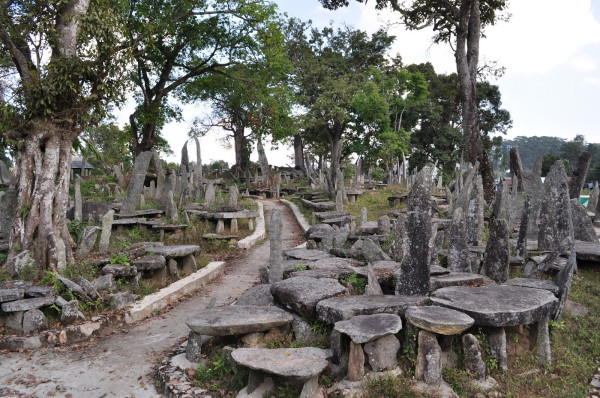
The Ancient Monoliths of North Cachar, located in present-day Dima Hasao district of Assam, represent one of Northeast India's most fascinating yet under-researched prehistoric legacies. These remarkable stone jars, along with menhirs and dolmens, form a unique megalithic landscape that reflects complex burial traditions, early metallurgy, and possible cultural links between Northeast India and Southeast Asia.
Often compared to the famous jar sites of Laos, the monoliths of North Cachar continue to intrigue archaeologists, historians, and cultural researchers alike.
Historical Documentation and Research Background
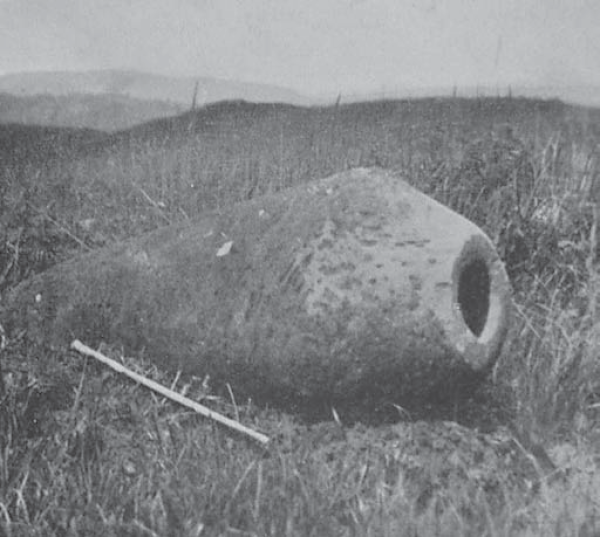
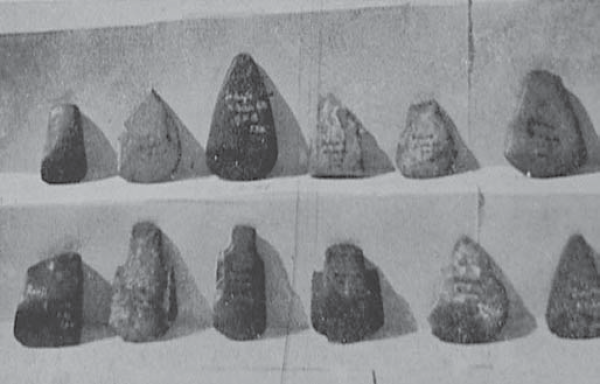
The stone jars of North Cachar were first systematically documented in 1932 by J.P. Mills and J.H. Hutton. Their detailed report, published in the Journal of the Royal Asiatic Society of Bengal, described the jars’ shapes, sizes, locations, and possible ethnic associations. They also recorded the discovery of Neolithic celts and human skeletal remains inside some jars.
Despite the importance of their findings, very little follow-up research was conducted for nearly eighty years. This prolonged academic neglect created a significant gap in archaeological and anthropological understanding of the region.
Recent explorations using modern archaeological techniques have attempted to relocate the original jar sites, identify new ones, and investigate associated habitation areas to better understand the cultural behavior of the communities that created these monoliths.
Geographic Distribution and Key Sites
The monoliths are spread across the hills of Dima Hasao, particularly in the Haflong and Maibang subdivisions. Important locations include:
-
Nuchubunglo (earlier reported as Bolason village)
-
Areas near Kasomari Pathar
Nuchubunglo Site
Nuchubunglo lies about 40 km northwest of Haflong town. The present inhabitants are Zemi Nagas, and the name Nuchubunglo means “hill of stone jars.” The jars are located about 1 km northeast of the village, positioned on hilltops and slopes, surrounded by dense vegetation.
Historically, around 400 jars were recorded at this site. Today, only about 180 remain traceable. Many were damaged due to shifting cultivation (Jhum), natural weathering, and human interference. Some smaller jars were moved and placed at village entrances and religious sites, including the Heraka temple.
Originally, the site had protective iron fencing installed during early documentation efforts, but no trace of it remains today.
Physical Characteristics of the Stone Jars
All jars were carved from locally available sandstone blocks. Their average heights range from 50 cm to 150 cm, with some elongated types measuring up to 180 cm.
Four major types of jars have been identified:
Type I – Elongated Bi-Cone Shape
-
Edge not centered, closer to the cavity apex
-
Opposite apex pointed
-
Length between 150 cm and 180 cm
-
Rare at the site
Type II – Centered Bi-Cone Shape
-
Edge nearly at the center
-
Broader cavity end
-
Length between 40 cm and 70 cm
-
One of the dominant types
Type III – Cylindrical Shape
-
Narrow base
-
Wider cavity opening
-
Limited presence
Type IV – Convex Bi-Cone Shape
-
Height smaller than diameter
-
Bulbous appearance
-
Prominent edges
-
Common at Nuchubunglo
The depth of the internal cavity varies from 10 cm to 60 cm. The cavities are relatively narrow, and today all jars are empty.
Purpose and Burial Practices
Archaeological evidence strongly suggests that the jars functioned as burial urns or repositories for human remains. Earlier records mention discoveries of bone fragments and artifacts inside the jars, indicating post-cremation or secondary burial practices.
Such mortuary traditions closely resemble megalithic burial customs observed in Southeast Asian regions, particularly in Laos and Vietnam.
Engravings and Artistic Features
Some jars feature carvings such as:
-
Human footprints
-
Triangles
-
Circles
Nearby flat stone slabs, found approximately 1 km south of the jar cluster, bear engravings of human faces and geometric symbols. These stone surfaces suggest possible ritual or habitation activity in the surrounding area.
Although pottery remains have not been recovered, the landscape indicates past human occupation or ceremonial use.
Cultural and Ethnic Theories
Early scholars proposed that the jars were not created by present-day Naga tribes but possibly by earlier non-Naga populations. Theories suggest connections to Khasi-Synteng groups or the Mikirs.
A particularly significant hypothesis links the North Cachar jars to Southeast Asia. Research on jar sites in Laos proposed that Austro-Asiatic speaking communities, active around 800–700 BCE, may have carried their megalithic traditions along ancient salt trade routes extending into Northeast India.
Later studies in Laos dated similar jars to the end of the second millennium BCE, strengthening the possibility of ancient trans-regional cultural interaction.
These findings are crucial for understanding:
-
Early migration patterns in Northeast India
-
Megalithic cultural expansion
-
Possible early knowledge of iron technology in the region
Archaeological Importance and Current Condition
The monoliths of North Cachar represent a rare prehistoric cultural expression unique within India. Their closest parallel exists in Southeast Asia, making them globally significant.
However, the site faces serious challenges:
-
Vandalism
-
Agricultural disturbance
-
Weather damage
-
Lack of sustained conservation
Once officially protected, the absence of long-term preservation efforts has resulted in significant loss. Today, the jars stand as fragile witnesses to a prehistoric civilization that still remains largely unexplored.
Why the Ancient Monoliths Matter Today
These stone jars are more than archaeological objects. They represent:
-
One of Assam’s oldest cultural traditions
-
Evidence of prehistoric burial systems
-
Possible early cross-cultural exchange between India and Southeast Asia
-
Insights into ancient technology and ritual life
Further systematic excavation and conservation could reveal crucial evidence about early iron usage, settlement patterns, and ethnic formation in Northeast India.
Conclusion
The Ancient Monoliths of North Cachar in Dima Hasao form a remarkable chapter of Assam’s archaeological heritage. From their mysterious hollow interiors to their engraved symbols and Southeast Asian parallels, these stone jars continue to raise important questions about migration, trade, ritual, and identity in prehistoric Northeast India.
Preserving and studying them is essential not only for Assam but for understanding broader patterns of ancient human civilization across Asia.